

Your Heart After Cancer: What the Research Says About the Risks Nobody's Watching
Estrogen is More Than Fertility: The Silent Cardiovascular Cost of Early Medical Menopause

When Dr. Anju Nohria told me that the leading cause of non-cancer death in cancer survivors is heart disease, I wasn’t surprised by the fact. I was surprised that in nearly 20 years of post-treatment life, no one in my care team had said it to me directly.

In fact, Dr. Norris shared that there is NO research on the impact of early medical (surgical or chemical) permanent menopause on cardiac health.
The population who experienced early menopause was both too small and historically died too young for research. Both of those factors are no longer true.
That gap between what the research shows and what patients are told is what this episode is really about. So I went looking for the data behind what Dr. Nohria described, and the picture is stark.
The scale of the problem
A 2024 systematic review and meta-analysis published in Cancer Medicine, covering 136 studies from 16 countries with sample sizes ranging from 157 to over 7.5 million, found that cancer survivors face a 55% higher risk of cardiovascular death compared with the general population. That’s not limited to patients who received the most aggressive treatments. The elevated risk held across nearly all individual cancer types, from a 14% increase in testicular cancer survivors to a nearly threefold increase in brain and central nervous system tumor survivors.
A 2025 UK Biobank cohort study and meta-analysis of 104 published cohorts, totaling nearly 40 million participants, found a 34% increased cardiovascular risk among cancer survivors even after adjusting for competing risks. Notably, that association was consistent regardless of whether patients had received chemotherapy or radiation. That last finding matters. It suggests the relationship between cancer and heart disease is more complex than treatment toxicity alone.
And yet, as Dr. Nohria explained in our conversation, “people who have traditional cardiac risk factors, whether it be high blood pressure, high cholesterol, diabetes, obesity, sedentary lifestyle, smoking, are at higher risk for developing cardiotoxicity.” Those risk factors don’t pause during cancer treatment. They compound.
The silent damage problem
What makes this especially dangerous is that early cardiac damage is almost always asymptomatic. Dr. Nohria was blunt: “You don’t usually feel any symptoms from cardiac damage until you have overt heart disease.” The fatigue, the shortness of breath, the chest tightness that might signal a cardiac problem are indistinguishable from the side effects of cancer treatment itself. By the time symptoms are clearly cardiac, you’ve likely missed the optimal intervention window.
A 2024 JACC: CardioOncology expert panel review confirmed that current guidelines recommend annual clinical screenings and cardiovascular risk factor optimization for all cancer survivors, with additional testing for higher-risk patients. Yet the panel noted significant gaps in the existing literature regarding how to implement that surveillance effectively.
In other words, the guidelines exist. The infrastructure to deliver them to every cancer survivor does not.
For patients treated with anthracyclines specifically, the numbers are sobering. In a study of Hodgkin lymphoma survivors, anthracycline exposure increased the risk of heart failure by a factor of nearly three. For those who also received chest radiation at higher doses, the 25-year cumulative risk of heart failure reached nearly 33%. These are not small numbers. And they play out over decades, long after oncology has signed off.
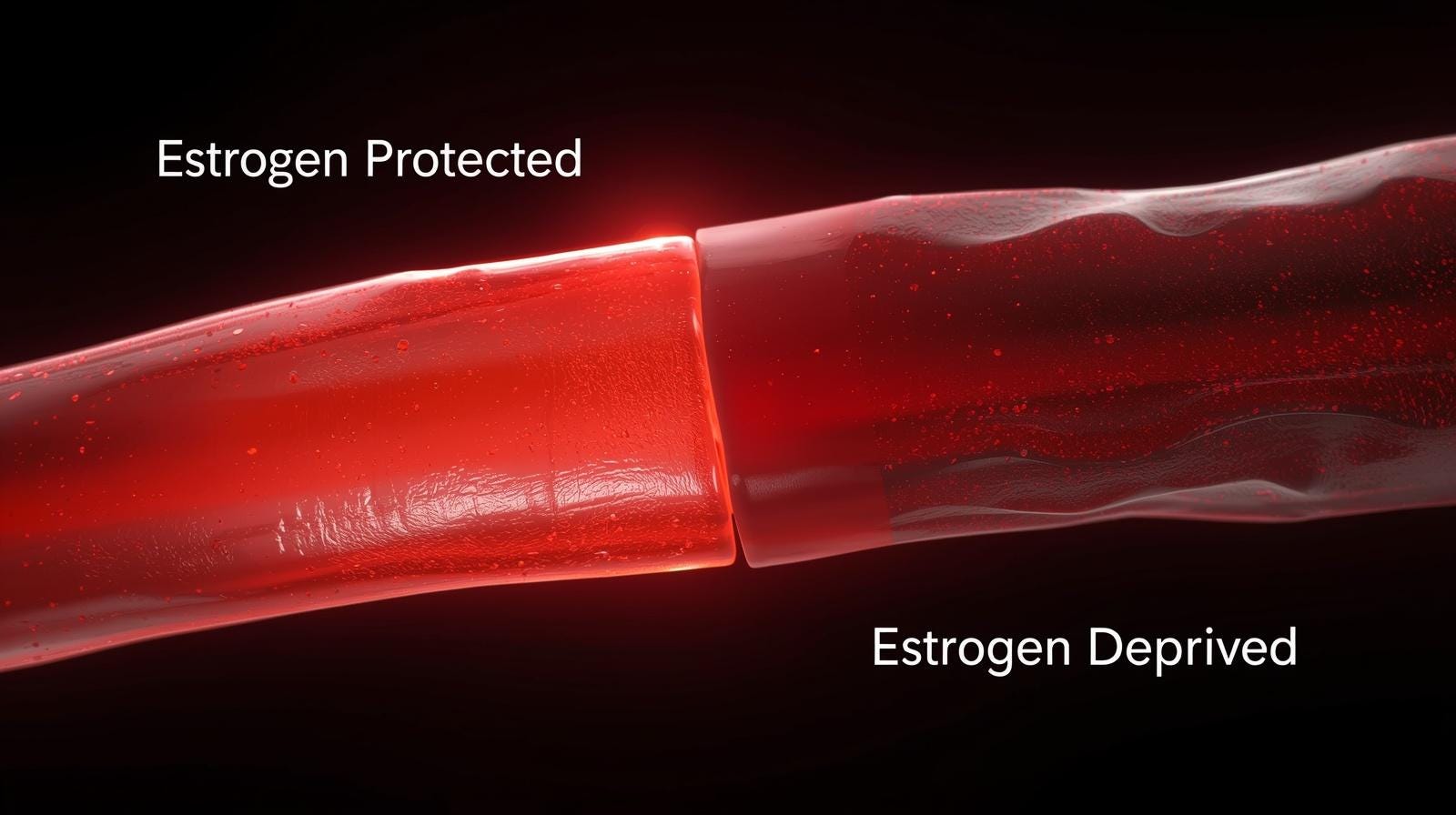
The estrogen gap nobody’s watching
This is personal for millions of women who’ve been through cancer treatment and for me. My geneticists and OB-GYN recommended a prophylactic salpingo-oophorectomy to prevent ovarian cancer, which is notoriously difficult to detect early. It was the right call. Even knowing what I know now about the cardiac implications 20 years later, I’d make the same decision. Ovarian cancer is a threat you can remove. But removing my ovaries also removed my estrogen. And nobody connected that to my cardiac future for the next two decades.
Estrogen isn’t just about fertility. As Dr. Nohria explained, “estrogen is so important for making your blood vessels flexible. It’s important for cholesterol metabolism.” Losing it prematurely accelerates cardiovascular risk in ways that most care teams aren’t monitoring, especially when the surgery was preventive, and the patient isn’t being followed by oncology anymore.
The North American Menopause Society’s position statement is clear: women with premature or early menopause have higher risks of bone loss, heart disease, and cognitive disorders associated with estrogen deficiency, and hormone therapy is recommended at least until the average age of natural menopause unless contraindicated.
But here’s the bind: if you had estrogen-receptor-positive breast cancer (I did not), systemic estrogen replacement is generally off the table because it raises the risk of recurrence. The surgery that prevented one cancer removed a hormone your heart needs, and the replacement that could help your heart might feed a different cancer. That’s not a failure of any single doctor. It’s a failure of connection between specialties.
A 2025 consensus statement in Menopause from a 25-member multidisciplinary panel acknowledged that breast cancer survivors struggle with menopausal symptoms due to treatment-induced hormone deficiency, but that estrogen replacement is not recommended after breast cancer because it can increase the risk of relapse. The panel also noted that transdermal estradiol carries a safer cardiovascular profile than oral formulations, with a lower risk of blood clots and stroke. Vaginal estrogen, which isn’t absorbed systemically in meaningful amounts, addresses genitourinary symptoms but isn’t likely to protect the heart. Neither is approved for cardiac prevention, but transdermal delivery has some potential to provide some cardiovascular benefit with lower risk than oral estrogen.
Women who initiated estrogen therapy during perimenopause had approximately 60% lower odds of developing breast cancer, heart attack, and stroke compared with those who started after menopause or never used hormones.
A large study presented at The Menopause Society’s 2025 Annual Meeting found that women who initiated estrogen therapy during perimenopause had approximately 60% lower odds of developing breast cancer, heart attack, and stroke compared with those who started after menopause or never used hormones. The timing question matters enormously. And for women like me who had a prophylactic oophorectomy years ago, the timing window may have already closed.
Dr. Nohria suggested something important: depending on your cancer type, you may be able to take some form of estrogen supplementation, and the conversation should involve a subspecialist who understands the intersection of oncology and endocrinology. “Those people exist,” she said. “It’s just that they’re kind of siloed in the major academic oncology centers.”
What you can do right now
If you’re a cancer survivor or someone who is a previvor who has done prophylactic cancer prevention, here’s what this research and this conversation point toward:
Ask your oncologist for a cardiac risk summary based on your specific treatments. Don’t assume someone else is tracking this.
Get your blood pressure checked and tracked regularly. Dr. Nohria called it the single most predictive cardiac metric.
Consider comprehensive cardiovascular screening including blood work and CT calcium score.
If you went through early menopause because of treatment, ask about a referral to an onco-endocrinologist or a menopause specialist with cancer experience. Don’t assume your standard OB-GYN has the expertise for this specific situation.
Don’t stop managing your existing cardiovascular risk factors just because you’re focused on cancer. Cholesterol, blood pressure, blood sugar, weight, and exercise. None of these takes a break because you have a diagnosis.
The system is getting better at keeping us alive through cancer. It’s not yet good enough at watching what happens to our hearts afterward. Until it is, that job falls to us.

New episode of Kicking Cancer’s Ass. Listen wherever you get your podcasts.
Research sources cited:
Ng et al. — “Cardiovascular mortality in people with cancer compared to the general population: A systematic review and meta-analysis,” Cancer Medicine, 2024
Mulder et al. — “Risk of Cardiovascular Disease in Cancer Survivors after Systemic Treatment: A Population-Based Cohort Study,” JACC: CardioOncology, 2025 https://www.jacc.org/doi/10.1016/j.jaccao.2025.03.008
Tung et al. — “Cardiovascular disease risk in cancer survivors: a population-based cohort study from the UK Biobank, and meta-analysis of cohort studies,” Heart, 2025 https://pubmed.ncbi.nlm.nih.gov/40017970/
JACC: CardioOncology Expert Panel — “Cardiovascular Considerations After Cancer Therapy: Gaps in Evidence and Expert Panel Recommendations,” 2024
Consensus statement on menopausal hormone therapy after breast cancer — Menopause, 2025
North American Menopause Society Position Statement — 2022 https://www.letstalkmenopause.org/our-articles/nams-2022-hormone-therapy-position-statement
Chidi et al. — “When Women Initiate Estrogen Therapy Matters,” presented at The Menopause Society Annual Meeting, 2025 (reported by Contemporary OB/GYN) https://www.contemporaryobgyn.net/view/early-estrogen-use-linked-to-lower-disease-risks
Zhu et al. — “Cardiovascular Mortality Risk After Cancer Diagnosis by County-Level Characteristics in the United States 2000–2021,” Cancer Medicine, 2026 https://pmc.ncbi.nlm.nih.gov/articles/PMC12935517/
Watch the full interview here: