
When Your Cure Becomes Your Enemy
What a Poet Learned About Surviving the Impossible - Brad Buchanan

Brad Buchanan carries his brother’s DNA in every cell of his body. It’s keeping him alive. It’s also trying to kill him.
This is the paradox of graft-versus-host disease after a stem cell transplant. The new immune system that destroyed Brad’s cancer also attacks his body as foreign territory. It’s ravaged his eyes, his esophagus, his skin, his organs. It could flare up tomorrow and send him back to the hospital.

And Brad—a poet and former English professor—uses the exact same tools he taught his students for analyzing literature to make sense of this impossible reality.
Here’s what he learned that might help you survive your own impossible thing.
The Science of Fighting Yourself
First, understand what GVHD actually is, because knowledge is the first tool for emotional survival.
When you get a stem cell transplant, doctors wipe out your entire immune system with chemotherapy and radiation. Then they give you someone else’s—usually from a sibling, sometimes from a stranger. That donor’s immune system becomes yours permanently.
In acute GVHD, which typically happens within the first 100 days, the new immune system sees your organs, skin, and tissues as invaders. It attacks. Hard. Brad’s case was severe enough that his doctors told his wife nine out of ten people would die.
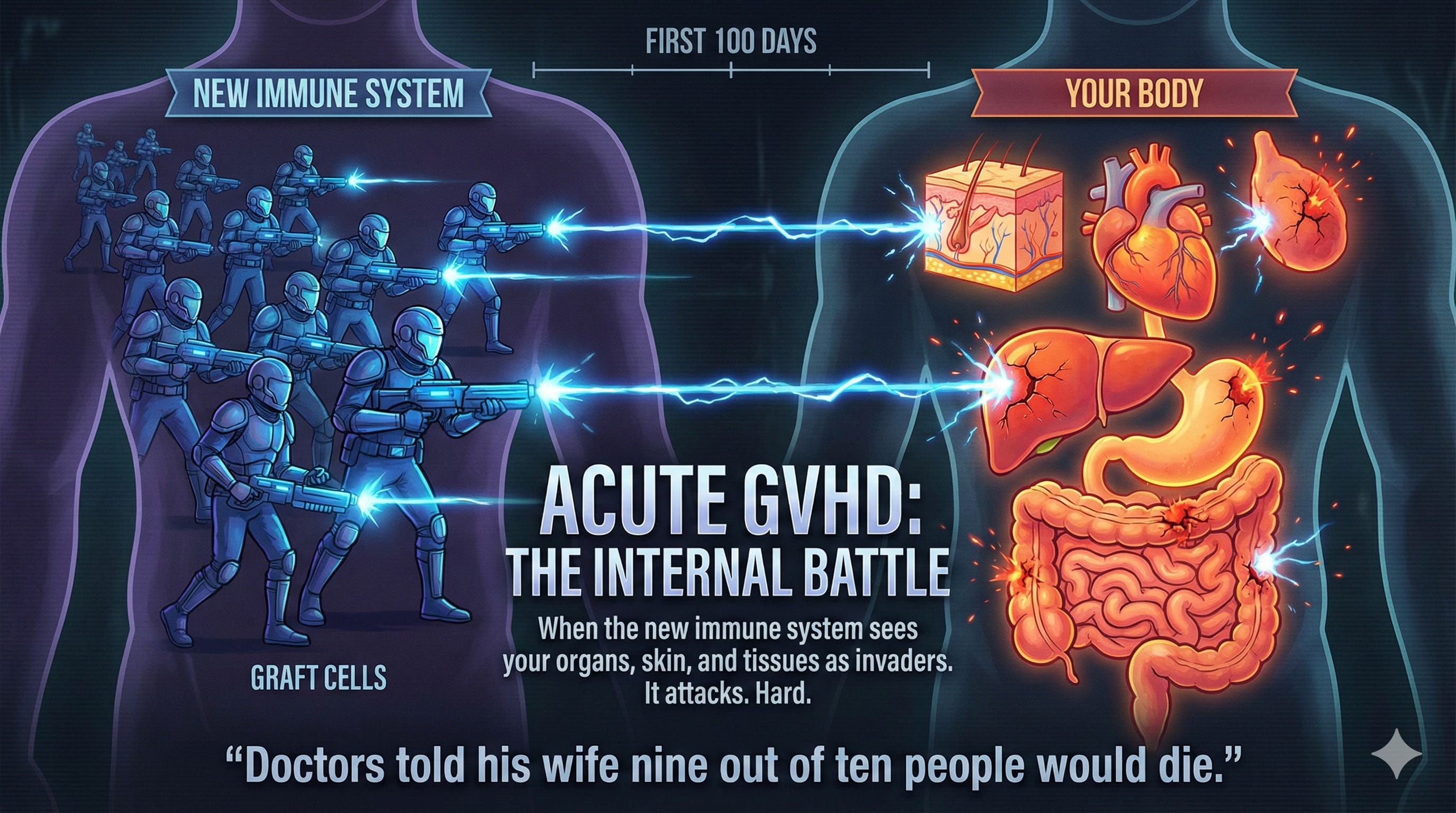
Here’s the twist: that aggressive immune system is also hunting down any remaining cancer cells. As Brad’s oncologist explained, “a little bit of graft-versus-host disease is a good sign. It’s a sign that your new immune system is working properly and will likely fight against your cancer.”
The thing trying to destroy you is the thing protecting you.
How do you make peace with that?
The Poet’s Toolkit for the Unspeakable
Brad spent his career teaching students how to find meaning in stories, how to sit with paradox, how to express the inexpressible through metaphor and language.
When cancer stripped away his profession, his athletic abilities, his vision, everything he identified with—those literary tools became survival tools.
“Writing to me was kind of just emergency coping mechanism number one,” Brad told me. “The night I was in the hospital with the tumor bursting in my lung, I was sitting there for hours with nothing to do, nothing to think about. Okay, well here’s a chance to write a poem. Here’s what it’s like to be in this emergency room, hooked up to this machine, hoping that I’m not gonna die tonight.”


The intensity produced good writing. But more importantly, it produced a way to process what was happening without falling apart.
Brad wrote a poem called “Genetically Modified Organism” that captures the GVHD paradox better than any medical explanation:
I am a genetically modified organism. One part of me does not like the others senses. A separate origin elsewhere. Hurts what hinders its self-expression... Hates my guts. With a torrid passion nose eye, I depend on its hostility to protect me from a still worse enemy. Loves me in spite of everything. Like an envious younger brother plots his revenge through a two-way mirror and watches me where I blindly suffer adrenaline of his anger.
Notice what he’s doing here: he’s taking the medical horror and transforming it through metaphor. The hostile immune system becomes a younger brother who doesn’t want you to die but doesn’t mind watching you suffer.
It’s “horribly unfair” to his actual brother, Brad admits. But poetry isn’t about fairness. It’s about finding language for experiences that break you.
The Chimera Identity
Brad calls himself a chimera—the medical term for someone with two types of DNA. In mythology, chimeras are creatures combining different animals into one body.

“It wasn’t exactly a compensation for all that I lost,” Brad said. “But a chimera... appealed to my own creative imagination as a poet because poets invent new ways of using language. You know, we come up with weird metaphors for our lives and try to describe the indescribable experiences of human suffering, love, death, whatever.”
This is the work cancer survivors face: creating a new identity when the old one is gone. Brad lost Professor Brad, Athletic Brad, Healthy Brad. He had to become something else.
The chimera metaphor gave him permission to be something new and strange. Something that didn’t exist before. Something that breaks the rules of what bodies are supposed to do.
If you’re trying to rebuild yourself after cancer has destroyed who you were, you need your own metaphor. Something that lets you be broken and whole at the same time. Something that acknowledges you’ll never go back to the old version while giving you permission to be whoever comes next.
Why Men Need to Write (And Why You Do Too)
Brad now runs writing workshops for cancer survivors, particularly men.
“Men are not encouraged to express their feelings to each other,” he explained. “Generally we’re socialized to be rugged, self-confident individuals projecting invulnerable strength. When something goes drastically wrong, like we get cancer, well, there’s no plan B. We deflect, deny, distract ourselves.”
That’s why men have worse mortality rates from the same cancers—they get diagnosed later because they avoid getting into the doctor.
But when Brad gives men an assignment— “Hey buddy, time to write about your cancer experience”—something opens up. They pour the shutdown emotions onto the page. They discover they’re not alone.
Studies show men benefit more from writing as a therapeutic technique than women do, partly because other emotional outlets are less available or less culturally acceptable.
You don’t have to be a poet. You don’t have to share what you write with anyone. But you need somewhere to express what’s happening that isn’t yelling at people, drinking yourself to death, or pretending you’re fine.
The Fighting Metaphor Trap
Here’s where Brad’s literary analysis gets practical.
We talk about “fighting” and “battling” cancer constantly. Those metaphors serve a purpose—they helped Brad get through brutal treatments when he was squeamish about needles.
But they can also trap you.
“Sometimes it gets hard to unhook from the fight or flight reflexes,” Brad said. “Use those metaphors when they serve you, when you absolutely need them. And then when they stop being useful, say, we’re done. We’re chilling at this point.”
His wife used to tell him: “Brad, don’t be a hero.” And he’d realize—you’re right, I don’t have to be a hero today. I can just stay in bed.
Fighting takes enormous energy. You can’t maintain that stance forever. But you can always trap moments of happiness. Write a poem. Text a friend. Hold someone’s hand.
Those moments help your immune system. They help your heart. And unlike fighting, you can do them every single day.
What This Means for You
Brad’s still here because he turned his literary toolkit into survival tools:
Metaphor to make sense of paradox
Writing to process the unspeakable
Poetry to transform trauma into meaning
Community to remember he’s not alone
Permission to stop fighting when he needs to rest
You don’t need a PhD in literature. You need language for what’s happening to you. You need a way to express the rage and fear and gratitude that cancer brings without imploding.
Start writing. Three sentences a day. What happened. How did you feel? What did you notice?
Find your metaphor. What creature are you becoming? What story helps you make sense of this?
And remember Brad’s pinky promise to his daughter: he’d survive long enough to meet her children.
Sometimes survival isn’t about fighting harder. It’s about knowing what you’re surviving for.
Get the full episode.
Listen on Apple Podcasts
Listen on Spotify
Listen on YouTube: https://urlgeni.us/youtube/GVHDpoet
Links
Read Brad’s book: “Living with Graft versus Host Disease: How I Stopped Fighting Cancer and Started Healing”
Engage with ManUpToCancer