
When 70% Feels Like a Miracle
And Why We Can’t Stop Now

My mother was 36 when breast cancer came for her. The year was 1983, and the odds weren’t in her favor. Only half of the people diagnosed with cancer were surviving five years back then. Half.
She’s 77 now. Thriving. Traveling. Living.
My sister beat it. Twice.
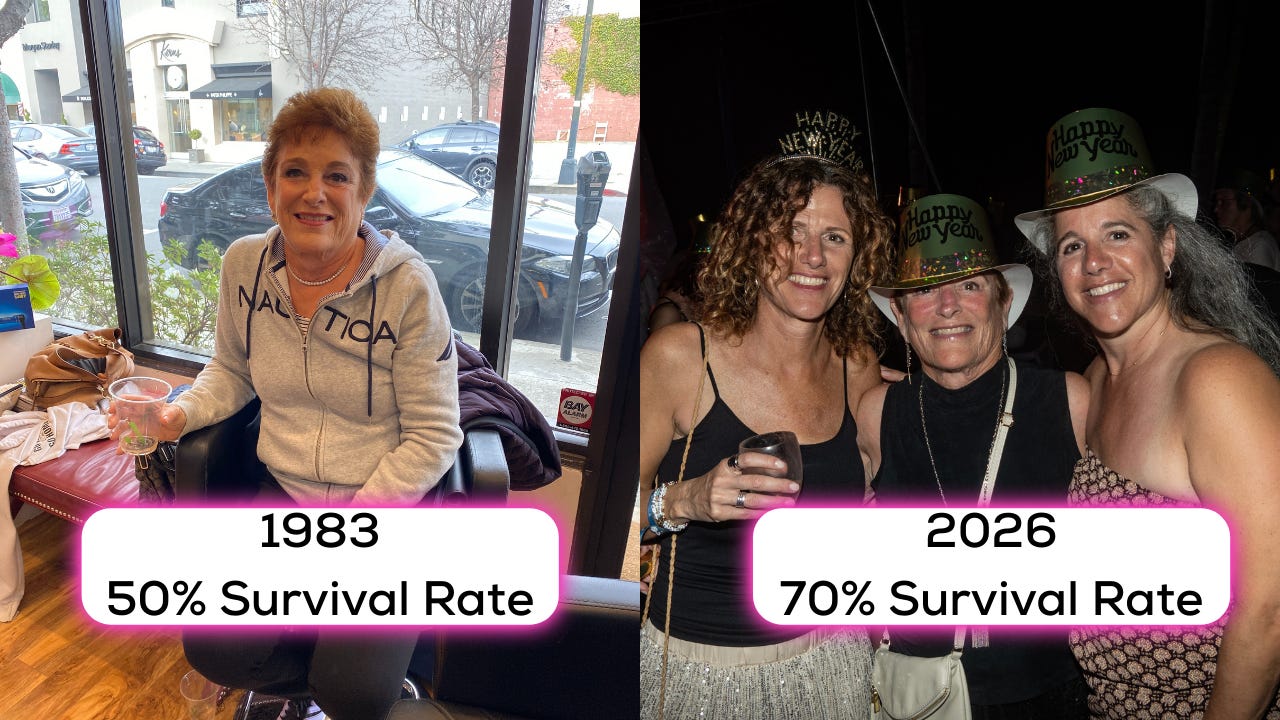
And after my triple-negative breast cancer diagnosis in January 2023, I’m here writing this to you.
Last week, the American Cancer Society released their annual Cancer Statistics report, and the headline is awesome: For the first time in history, seven in ten people diagnosed with cancer between 2015 and 2021 are surviving at least five years.
Seventy percent.
Damn.
What Changed Between My Mother’s Diagnosis and Mine?
When my mom faced her diagnosis, the medical arsenal was limited. Chemotherapy was brutal and often ineffective. Radiation was blunt-force trauma. Targeted therapies didn’t exist. Immunotherapy was science fiction.
Today? Rebecca Siegel, the American Cancer Society’s senior scientific director of surveillance research, calls it “a stunning victory.” She’s right. Because the numbers tell a story of scientific courage and relentless innovation.
Some of the deadliest cancers saw the most dramatic improvements:
Myeloma (a blood cancer): survival nearly doubled from 32% to 62%
Liver cancer: survival more than tripled from 7% to 22%
Lung cancer: jumped from 15% to 28%
Even more striking? For people diagnosed with distant-stage cancer—meaning the cancer has already spread to other parts of the body—five-year survival has doubled from 17% to 35% since the mid-1990s.
Doubled. For metastatic cancer.
Think about what that means for real people. Stage 4 doesn’t mean the same thing it meant when my mother was diagnosed. I know thrivers who are NED (No Evidence of Disease) years after metastatic diagnoses. They’re not just alive—they’re vibrant, working, parenting, loving their lives.
The Research That Saved Lives
This didn’t happen by magic or luck. It happened because researchers asked bold questions. Because someone funded experiments that seemed impossible. Because scientists took risks on treatments that hadn’t been proven yet.
The report estimates that 4.8 million cancer deaths have been prevented since 1991. Nearly five million people who are here today, living their lives, because of decades of investment in cancer research.
What drove this progress? Three major forces:
Smarter detection. We’re finding cancers earlier, when they’re easier to treat. Screening technologies have evolved dramatically. The HPV vaccine combined with cervical cancer screening could actually eliminate cervical cancer entirely.
Better treatments. Immunotherapy—engineering your own immune system to recognize and attack cancer cells—has been transformative, especially for myeloma and lung cancer. Targeted therapies go after specific genes or proteins that help cancer grow, causing less damage to healthy cells and fewer side effects.
Fewer smokers. Smoking rates dropped from 42% in 1965 to about 11% in 2021. That single public health victory ripples through the cancer statistics in profound ways.
But Are We Losing Momentum Just As We’re Gaining the Upper Hand?
Just as we’re seeing these remarkable gains, federal funding for cancer research is being slashed. A Senate analysis found a 31% decline in National Cancer Institute grant funding in just the first three months of 2025 compared to the year before.
Thirty-one percent. In three months.
This isn’t abstract. Every percentage point in that 70% survival rate represents tens of thousands of people who are here because someone funded the research that led to their treatment. Every improvement in distant-stage cancer survival came from decades of investment in understanding how cancer works, how it spreads, and what stops it.
What happens when we cut that pipeline?
The Math of Progress—And What’s Missing
Yes, 70% is extraordinary. But let me be direct about what that number also means: Three out of every ten people diagnosed with cancer still won’t make it to five years.
The report projects that in 2026, more than 2.1 million Americans will be diagnosed with cancer, and over 626,000 will die from it. Lung cancer alone will kill more people than the next two deadliest cancers—colorectal and pancreatic—combined.
And the burden falls unevenly. The overall cancer mortality rate for Black men is 14% higher than for white men. Access to high-quality care, socioeconomics, and systemic inequities still play massive roles in who survives and who doesn’t.
So What Do We Do With This Information?
First, we acknowledge the progress without becoming complacent. Seven in ten is a miracle compared to five in ten. But it’s not good enough yet. Not when we have the scientific knowledge to push it higher.
Second, we fight for continued research funding. The breakthroughs that turned my mother’s 50-50 odds into my 70% chance didn’t happen overnight. They took decades of investment. If we want tomorrow’s cancer patients to have 95% survival rates, we need to fund today’s “impossible” research.
Third, we become powerful partners in our own care. Early detection matters. Screening matters. Asking informed questions of your medical team matters. Understanding your options matters.
And fourth—maybe most important—we refuse the narrative of victimization. Cancer is terrifying. Treatment is brutal. But you are stronger than you think, and the science is on your side in ways it never was before.
My mother had half a chance. For early-stage breast cancer, the odds are now 9 in ten (over 90% survival for more than five years - personally, I want 50). My hope is that your children, if they ever face this disease, will have better.
But that only happens if we keep investing in research. If we keep pushing. If we refuse to accept “good enough” when lives are at stake.
Seventy percent is worth celebrating. It’s also a reminder of how far we still have to go—and why we can’t stop now.
What’s your experience with this shift in survival rates? Have you watched someone you love benefit from treatments that didn’t exist a decade ago? Or lost someone before these breakthroughs arrived? I’d love to hear your story in the comments.