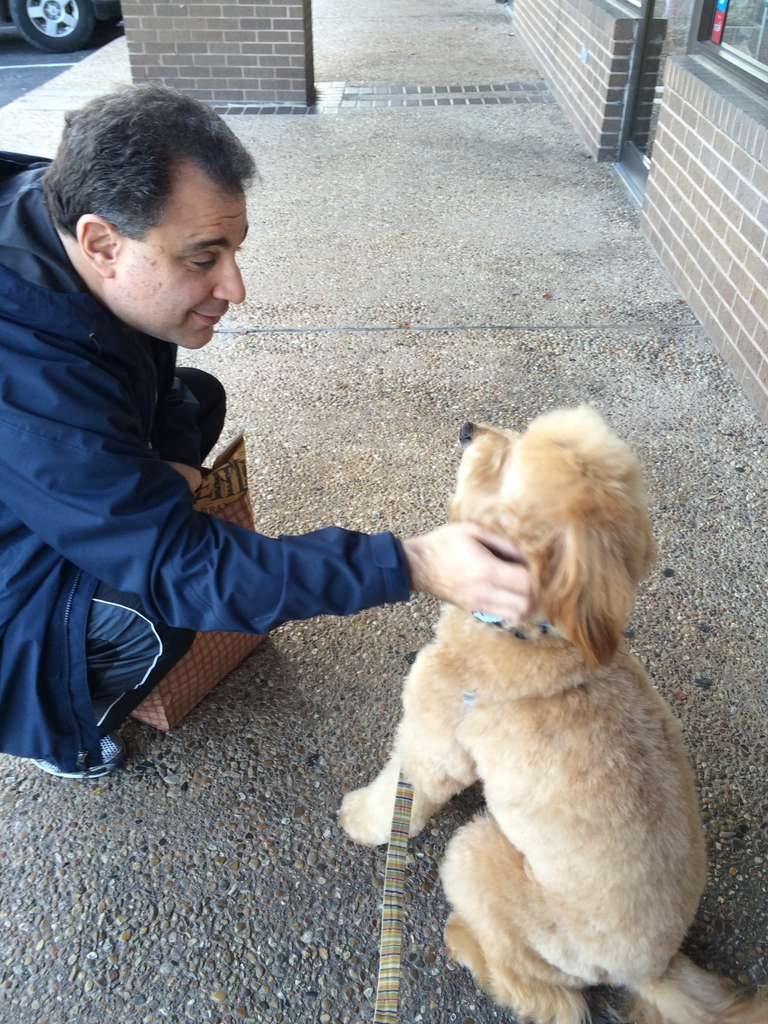
What Jeffrey Eisenberg Couldn't Say to His Best Friends
Episode #44: Jeffrey Eisenberg

After Jeffrey Eisenberg got out of treatment, two of his closest friends were trying to be kind. You must be so grateful, they told him.
He looked at them and said: Why aren’t you?
He’d been thinking it for months — watching healthy people congratulate him for a perspective they assumed was reserved for the nearly-dead — and one afternoon he just said it back to them. You have grandkids. You have all of this. What makes our next minute different from yours?
One of the two friends came back to Jeffrey weeks later and said the question had rocked his world.
Jeffrey had given himself permission, after working with his therapist, to stop filtering. So here it is, on the record for the first time: a three-time cancer survivor saying that the well are the ones squandering their lives, and the cancer patients are not the ones who need to be told to appreciate what they have.
The research backs him up — but in a more uncomfortable way than most readers will expect.
What the data actually shows
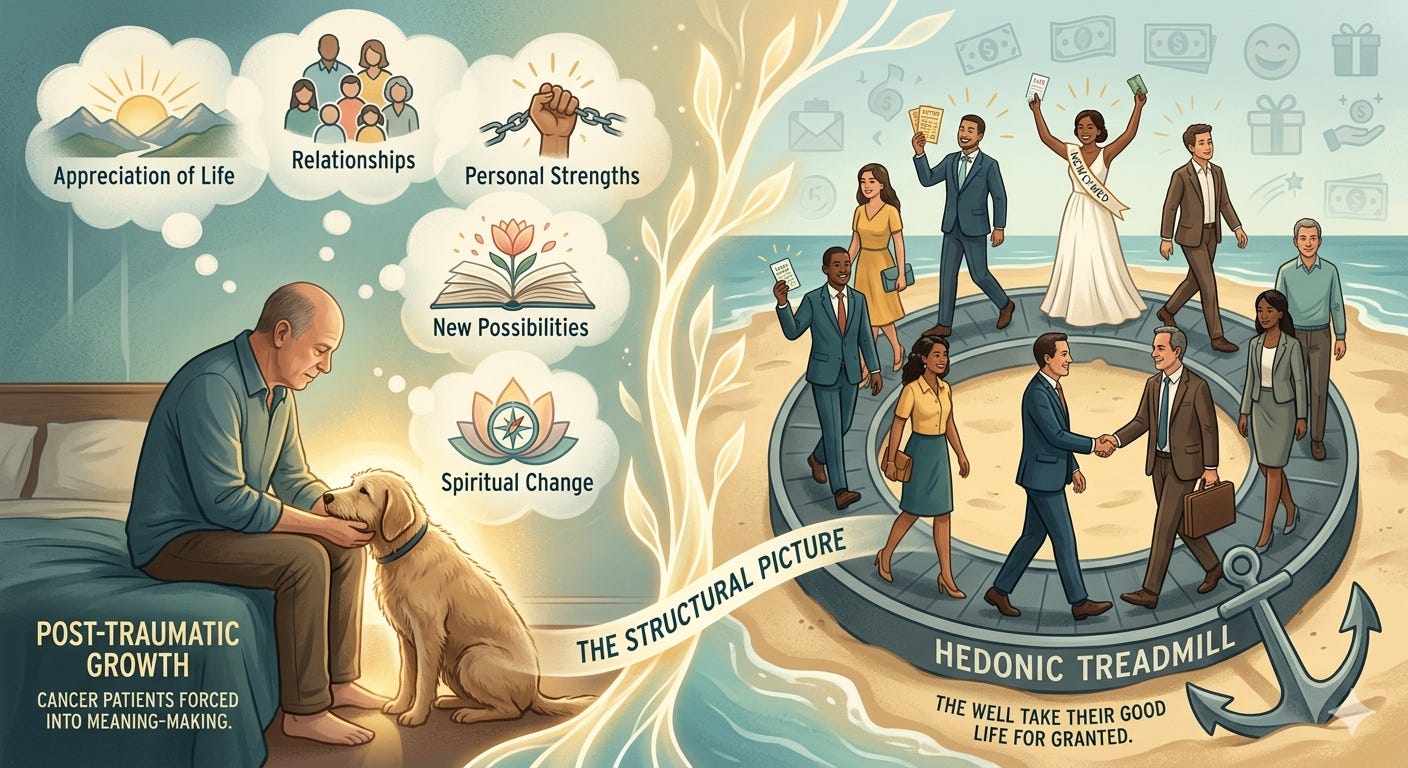
Post-traumatic growth — the term researchers use for the lasting positive psychological changes that follow a crisis — isn’t rare in cancer survivors. A 2024 longitudinal study of 1,316 cancer survivors found growth was measurable four years after diagnosis across five dimensions: appreciation of life, relationships, personal strengths, new possibilities, and spiritual change. A 2025 meta-analysis of breast cancer survivors put it more strongly: post-traumatic growth is “almost ubiquitous” in this population.
The piece most healthy people miss: survivors aren’t growing despite the trauma. They’re growing through what researchers call meaning-making — actively reframing the experience, asking what it’s for, deciding what to do with the time. A 2024 scoping review in Psycho-Oncology found the survivors who actively engage in cognitive processing of their illness — deliberate rumination, positive reframing, finding meaning — show greater growth than those who don’t.
The flip side is the part that should bother the well: there’s a robust body of research on what’s called the hedonic treadmill. Healthy people adapt to good fortune within months. Lottery winners. Newlyweds. People who land the promotion. Within a year or two, baseline life satisfaction returns. Sonja Lyubomirsky’s Hedonic Adaptation Prevention model is built on the observation that the average person, untouched by crisis, will reliably take their good life for granted within months of acquiring it.
The structural picture: cancer patients are forced into the meaning-making cancer requires, and they grow. The well are not forced into anything, and they adapt. Jeffrey’s question to his friends wasn’t unfair. It was statistically accurate.
What Jeffrey did differently
He stopped ranking his life against other people’s highlight reels. Jeffrey wrote a New York Times bestseller during the same stretch his company was going through an IPO. The IPO didn’t go well. The bestseller call came from his agent the day before publication. He was on the road, exhausted, miserable. What should have been one of the best moments was not, he said. The walk with his blind 13-year-old dog, post-treatment, was. He stopped comparing his life to other people’s highlight reels and started comparing his Tuesday afternoon to his other Tuesday afternoons.
He understood his father from the inside. Jeffrey’s father had mantle cell lymphoma. Doctors gave him under six months. He lived six and a half years. Four or five years in, Jeffrey asked his father if he had any regrets. His father laughed. No. None. Jeffrey thought he understood it at the time. He didn’t. It took his own diagnosis to realize what his father was actually saying — that the Sabbath meal, the granddaughter on his lap, the ordinary afternoons were the life. The big things weren’t separate from the small ones. The big things were the small ones.
He asked the question backwards. When Jeffrey was scared in the hospital, he didn’t ask “will I die?” He asked “what will I never see again? Who will I never see again?” Same question with a different center of gravity. The first asks what’s worth fearing. The second asks what’s worth protecting. He landed on the dog. Then, months later, the dog laid his head on Jeffrey’s foot one afternoon, and Jeffrey understood what the question was for.
What to do with this
Three things, if you’re in treatment, post-treatment, or watching someone you love go through it:
1. Stop waiting for the perspective shift. It isn’t the cancer that creates it. It’s the meaning-making. You can start that process today, regardless of your diagnosis.
2. Ask the question backwards. Not “will I die?” Try “what will I never see again? Who will I never see again?” That’s the cancer filter — and it points at what’s actually worth protecting.
3. If healthy people in your life tell you how grateful you must be, you don’t have to perform it. You’re allowed to ask them the question Jeffrey asked. Most won’t be ready for it. One or two will come back to you weeks later and tell you it changed something.
Jeffrey said the gift — and he flinched at the word, because he knows how cynical it sounds — is that he learned, three cancers in, that his next minute and his friends’ next minute are identical. It’s just a choice.
He’s right. The literature is on his side. And he was kind enough — and brave enough — to say it out loud for the first time. Jeffrey and I had known each other for years before any of this happened. He didn’t tell me he was sick. He waited until he was through it, then reached out because he wanted his story somewhere it might help someone else find their way through. That’s why this podcast exists. One person’s story becomes a model for the next person who needs one.