
Three Doctors, One Body, Nobody Talking
The gap between OB/GYN and oncology isn't a knowledge problem. It's a coordination problem. And women have been paying for it for a long time.

The Gap Between the Rooms
A few years after my cancer treatment, a hormone specialist prescribed estrogen replacement. She was managing the full picture—cardiac health, bone density, and libido. These are legitimate concerns, and she was doing exactly what she was trained to do.
Four weeks later, my radiologist called me:
“Joelle, what did you do? Your breasts have been calm for years and now they’re lit up and I don’t like it one bit.”
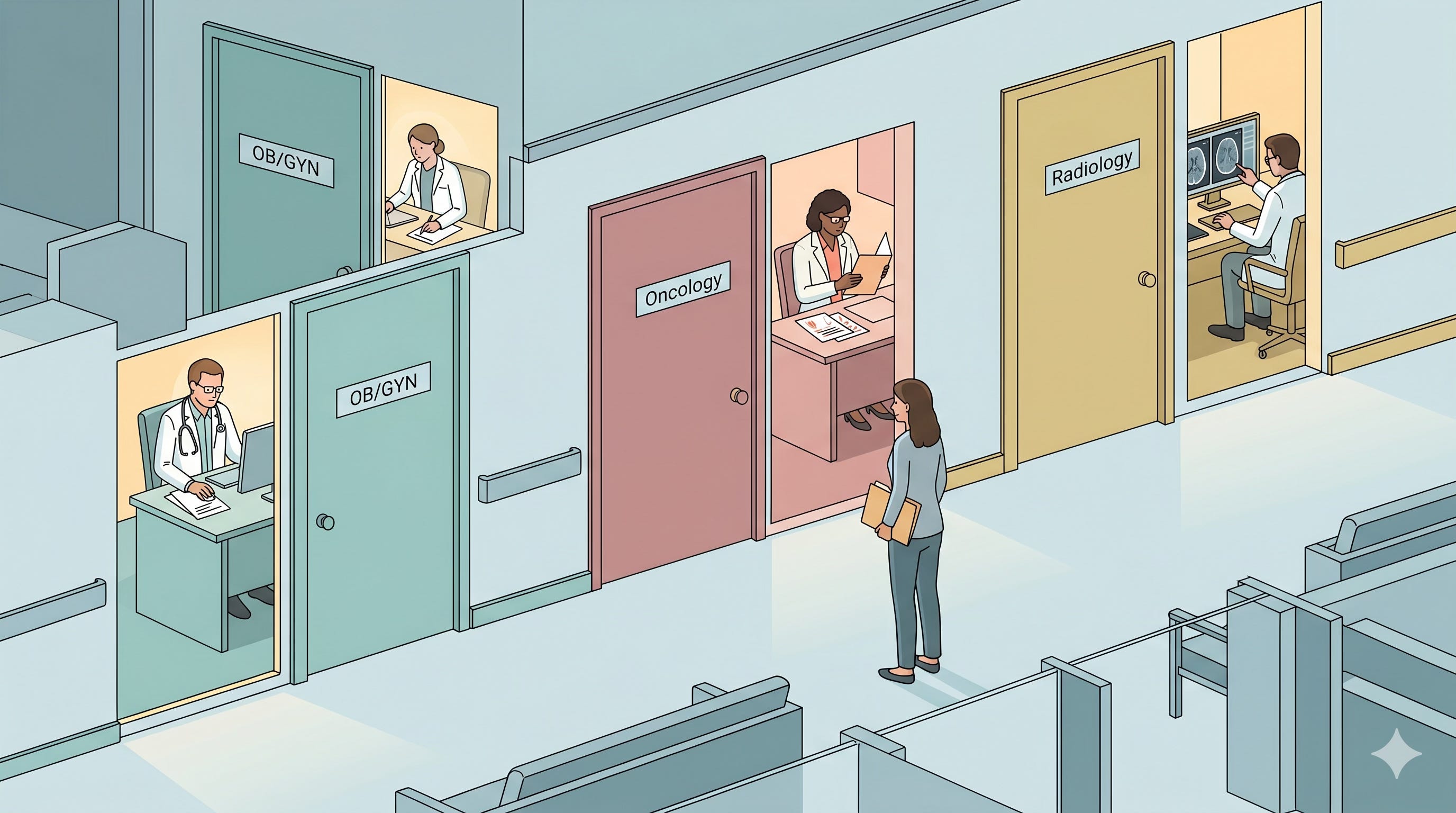
The hormone doctor didn’t know what estrogen would do on a breast MRI. The radiologist didn’t know what the hormone doctor had prescribed. I was the only person in all three rooms, and I didn’t know enough to connect the dots.
This isn’t a story about doctors who failed; it’s a story about how women’s bodies are divided among specialists operating without awareness of one another. Oncology, Gynecology, and Radiology live in different worlds.
The full episode with Dr. Abigail Liberty is on Spotify, Apple Podcasts, and YouTube.
The Manchester Revelation: Progesterone vs. Estrogen
Two years ago, Dr. Abigail Liberty (OB/GYN at OHSU) attended a conference where Dr. Sasha Howell presented research on anti-progestins.
For forty years, breast cancer prevention has been organized around estrogen (Tamoxifen, Aromatase inhibitors). However, the science points to a different driver:
The Luteal Phase: During the two weeks after ovulation, progesterone surges. Breast cells swell, immune cells flood in, and tissue remodels. Dr. Liberty describes it as the breast “preparing for battle.”
The Risk: This monthly high-activity window has a high error rate.
The Solution: Anti-progestins interrupt this cycle, keeping the breast in the quieter, lower-risk follicular phase.
The Invisible Medication
When an oncologist asked why this wasn’t being used in America, the answer was startling. The drug already exists—it’s called Ella (ulipristal acetate). It has been in U.S. pharmacies for twenty years as emergency contraception. The oncologists in the room had never even heard of it.
“I realized that oncologists had never heard of it. The medicine I prescribe every day — they had no idea it existed.”
— Dr. Abigail Liberty, OB/GYN, OHSU
Three Barriers to Progress
The reason Ella hasn’t crossed into cancer prevention isn’t due to science, but three structural barriers:
Stigma: Because it is used as emergency contraception, it faces social hurdles that make it harder to study for secondary uses.
Regulatory Entanglement: Because it is in the same class as medications used in abortion, it faces political scrutiny and artificial barriers.
Double Standard. In Europe, a higher daily dose of UPA was approved for fibroid treatment after showing a significant reduction in bleeding and pain in the PEARL clinical trials. When post-market data showed cases of drug-induced liver injury, it was pulled from the market. The liver injury rate was statistically equivalent to common antibiotics like Augmentin, antibiotics that remain on pharmacy shelves without question. The difference in treatment wasn’t a difference in risk. It was a difference in how seriously we take women’s pain. Fibroids are disabling. The standard applied to the drug that treated them was not the same as the standard applied to a drug treating a UTI. The drug was pulled because it treated “women’s pain” (fibroids), which is often taken less seriously than other conditions.
The full episode with Dr. Abigail Liberty is on Spotify, Apple Podcasts, and YouTube.
Looking Ahead
Dr. Liberty’s goal is to study whether the current 30mg dose of Ella can replicate the tissue-protective effects seen in European studies. This coordination failure isn’t just a communication problem; it’s a policy and patient safety problem.

Dr. Sasha Howell — the researcher behind the Manchester findings — joins Kicking Cancer’s Ass next week. His work is the scientific foundation for everything Dr. Liberty is trying to build clinically. Together, these two episodes make the case that the coordination failure between specialties isn’t just a communication problem. It’s a research problem, a policy problem, and a patient safety problem.
The fix starts with the question your doctor isn’t asking yet.
💡 What to Ask For Today
For Prevention: Ask your doctor for advanced provision of Ella (ulipristal acetate, 30mg). Having a prescription on hand reduces the time between identifying a risk and acting on it.
For Hormone Therapy: If you are on HRT, ask your hormone specialist and your radiologist if they have compared notes. If they haven’t, you must be the one to connect them.