

The Friends Who Disappear, and the Pack That Doesn't
The Science of the Pack: Why Men Need Community to Survive

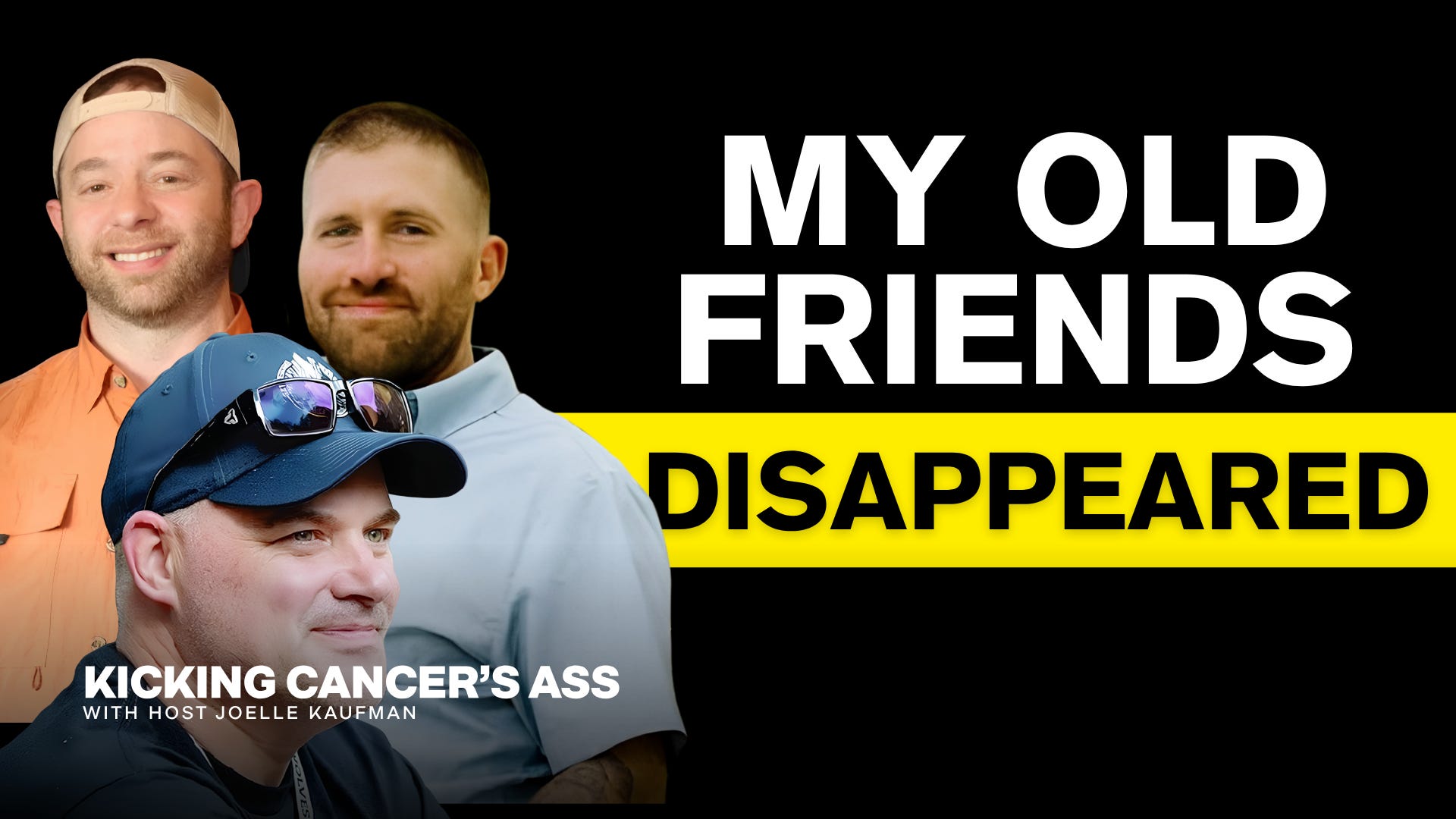
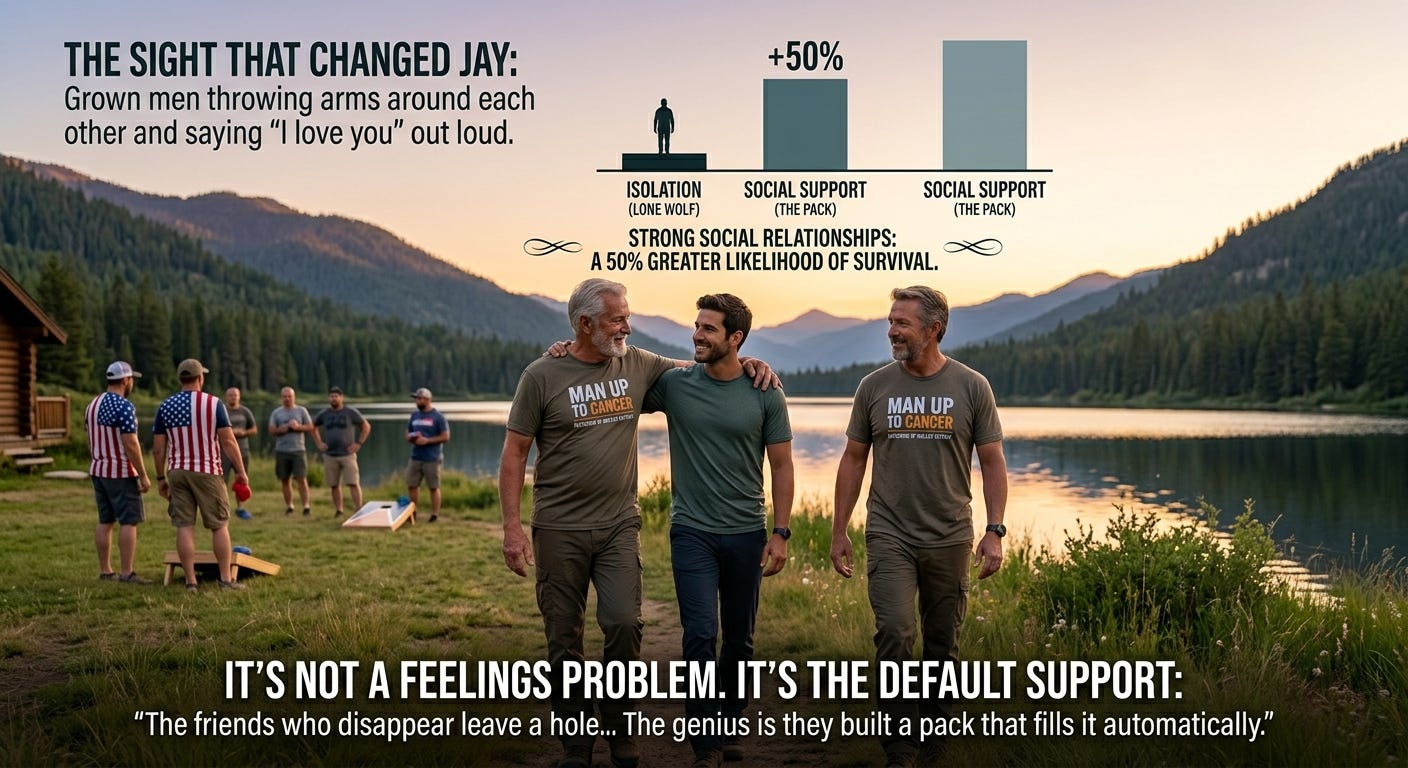
The first time Jay Abramovitch walked into a room full of men from the group, the first thing he noticed was the hugging. Grown men, a lot of them ex-military, ex-first-responders, the kind of guys who built whole careers out of not flinching, throwing their arms around each other and saying “I love you” out loud. For a beat he thought: what is going on here. He came from worlds where men did not talk about their problems, where you’d be the odd one out for admitting you were scared. Within a couple of hours, the nerves were gone. He was home.
The Reality of a Quiet Diagnosis
He had not felt at home in a while. Diagnosed at 36, healthy his whole life, physically demanding jobs in the military and the fire service, no family history, no warning. A little blood, some abdominal pain he could have blamed on stress. Then a colonoscopy in the middle of the pandemic, and a year and a half of surgeries and chemo he went through essentially alone; his wife Zoomed in from a parking lot because she wasn’t allowed inside. He had spent his entire life being the person who fixes things. Now he was the thing that couldn’t be fixed by anyone, least of all him.
The Grief Underneath
Here is what nobody warned him about. It wasn’t the chemo. When I asked all three men to name the thing nobody tells you, they answered in unison: the friends who leave. “The people back home either step up or they disappear,” Jay said. Don Helgeson, a three-time survivor, said he wouldn’t share his mental health low points with his regular friend group, only with these two men. Michael Riehle nodded along. This is the grief that lives underneath the diagnosis, and it has a particular cruelty for men, who tend, as Man Up to Cancer puts it, to “check out” when women would “reach out.”
I want to tell you the disappearing friends are just a sad footnote. They aren’t. They may be the most dangerous part of the whole thing.
The Actuarial Cost of Isolation
In 2010, researchers Martin Pinquart and Paul Duberstein pulled together 87 studies of cancer patients and found that people with high perceived social support had a 25 percent lower risk of dying than those without it. A larger social network, 20 percent. That same year, Julianne Holt-Lunstad’s team published a meta-analysis of 148 studies and more than 300,000 people showing that strong social relationships were associated with a 50 percent greater likelihood of survival, an effect they measured as comparable to quitting smoking and larger than the effect of obesity or physical inactivity. Read that again. The friend who stopped texting back was not a feelings problem. On the actuarial tables, his disappearance sat in the same column as a pack-a-day habit.
So when these men describe what the friends who left took with them, they are describing, without the citations, a withdrawal of one of the strongest predictors we have of who survives cancer and who finds any quality of life inside it. And when they describe what Man Up to Cancer gave back, they are describing the antidote being administered, on purpose, at scale.
The Problem with Support as Medicine
That’s the part I can’t stop turning over. Because the cruel thing about social support as medicine is that it arrives exactly when you are least able to go get it. You are flattened, bald, terrified, ashamed, and someone tells you community is the variable that matters most, so now you also have to summon the energy to build a community from a recliner. It’s like telling a drowning man that swimming lessons would have helped.
The Antidote: Automatic Community
What Don, Michael, and the late Danny Riggs did when they built the first Gathering of Wolves five years ago was take that impossible ask off the individual man. You don’t have to assemble a pack at your lowest moment. The pack already exists, and it comes to find you. There’s a buddy program now that pairs a senior wolf with a newcomer before the retreat, so a first-timer already knows one face when he arrives. One man, who’d never been to anything like it, told Don that knowing he’d be there waiting changed everything. Man Up to Cancer anticipates the needs of men facing cancer and meets them. The chemo backpacks ship to your door. The chapters, more than forty of them, meet whether you’re up to organizing anything or not. Two guys can apply for $100 to go to a baseball game. The support is not something you petition for. It’s the default. It’s automatic.
I have a name for this, from my own cancer years. I used to tell people I had an allergic reaction to pity, please don’t, and then I learned to give them instructions instead, the specific things that actually helped, so the people who loved me didn’t drift away from sheer not-knowing-what-to-do. I started calling them happiness tripwires: little mechanisms you set up in advance so the good thing happens to you without you having to ask for it in the moment you’re least able to ask. (And this Friday, June 26, I’m delivering a TEDx talk on Happiness Tripwires in Ypsilanti, MI - if you are nearby, please come join us, otherwise, look for the video in July). Man Up to Cancer is a happiness tripwire the size of a nonprofit. They wired the social support into the structure so that a frightened man would fall into it rather than climb toward it.
The Pack That Fills the Hole
Which brings me back to the hugging. At that first retreat there was a cornhole tournament, and someone wandered the grounds in a USA-flag speedo to distract the Canadian team. Year two, the toilets backed up and a three-time cancer survivor found himself unclogging a cabin commode an hour before dinner, thinking, I’ve come a long way in the cancer world, and this is where we’re at. They set aside time at the retreat to cry about the men who aren’t there, and then they tell jokes about them, because that’s what those men would want.
The friends who disappear leave a hole shaped exactly like the thing that keeps you alive. The genius of these men is that they stopped waiting for individual friends to be brave enough to fill it, and built a pack that fills it automatically, loudly, in a flag speedo, every September, on purpose.
Sources
Pinquart, M., & Duberstein, P. R. (2010). Associations of social networking and social support with cancer mortality. https://pmc.ncbi.nlm.nih.gov/articles/PMC2910231/
Holt-Lunstad, J., Smith, T. B., & Layton, J. B. (2010). Social relationships and mortality risk: a meta-analytic review. https://journals.plos.org/plosmedicine/article?id=10.1371/journal.pmed.1000316