

A study in BMC Cancer found that breast cancer survivors had HIGHER rates of depression and anxiety five to six years after diagnosis than they did 40 weeks in.
The distress didn’t peak during chemo and resolve. It built, year over year, fueled by recurrence fear and body changes and a social environment that had moved on. City of Hope (Emotional Health After Cancer Treatment) reports that more than 25% of long-term survivors experience clinical anxiety. Up to 25% experience clinical depression. Long after the bell has been rung.
This is the part of cancer your friends do not know exists. It isn’t in the brochures. It isn’t in the discharge instructions. There is no follow-up phone call about it.
Listen to the episode →. YouTube | Spotify | Apple | Everywhere
The Illusion of “Done”
Three years ago this month, an oncology nurse called and used the words every cancer patient wants to hear: Pathologically complete response. No cancer in any of the tissue they removed. Done.
I smiled. Maybe I cheered. Then I hung up and looked at my calendar.
The word done was on the chart. It was not on the calendar.
Was I done? I was done with the tumor that could have killed me. I was not done with the appointments that the tumor created.
You learn the choreography. You say good at the dinner party because the real answer takes forty minutes and nobody wants to hear it. You stop mentioning the appointments because you can hear yourself sounding like a complainer. You can’t say I have cancer anymore. You can’t say I had cancer yet, either. You stand in the gap, and the people who love you look at you like you should be happier by now. They’re not wrong to want that. You want it, too. Most days, I was happy. Some days, I was not.
The Reality of the Care Gap
The Institute of Medicine recommended in 2005 that every cancer patient finishing treatment receive a written survivorship care plan. The document is supposed to outline what surveillance you need, what late effects to watch for, who is coordinating among your specialists, and what to do if something changes.
Twenty years later, the National Coalition for Cancer Survivorship’s 2024 survey of more than 2,100 patients (2024 State of Cancer Survivorship Survey) found that fewer than half receive one. For a recommendation old enough to vote.
The Burden of Endocrine Therapy
Then there’s the medication. Hormone-receptor-positive patients are looking at five to ten years of endocrine therapy after surgery.
A 2025 study in The Breast Journal found that 87% of women on aromatase inhibitors experience side effects.
86% have musculoskeletal symptoms.
74.5% have hot flashes.
74.4% have fatigue.
Tamoxifen discontinuation rates run from 17% at two years to 49% at five, according to a population-based cohort study in the British Journal of Cancer.
Nearly half of women prescribed a drug to prevent their cancer from coming back stop taking it before the recommended course is up. Not because they’re careless. Because the side effects are debilitating and the support is inadequate.
Unseen Cardiovascular Risks
My cardiologist isn’t related to the chemo or the endocrine therapy. She’s there because I had my ovaries removed at 38 for genetic reasons.
A 2024 study in JACC: CardioOncology found that premenopausal women treated with aromatase inhibitors and ovarian suppression carry a two-fold higher risk of cardiovascular disease than those on tamoxifen alone. Within that same paper, data from the Nurses’ Health Study show that women who undergo bilateral oophorectomy without estrogen replacement carry a 2.35-fold higher risk of cardiovascular events.
The system that recommended my surgery at 38 didn’t add a cardiologist to my chart at the same time. It added one in my 50s, after it was too late to stop the problem and we were faced with containment options.
Standing in the In-Between
This is what done looks like from the inside. A drug that makes some women’s joints ache so badly they can’t keep taking it. The notification for the next surveillance scan. The new specialists you didn’t have before the diagnosis. The night the new sensation in your shoulder keeps you up because you’re not sure if it’s the pillow or the rest of your life.
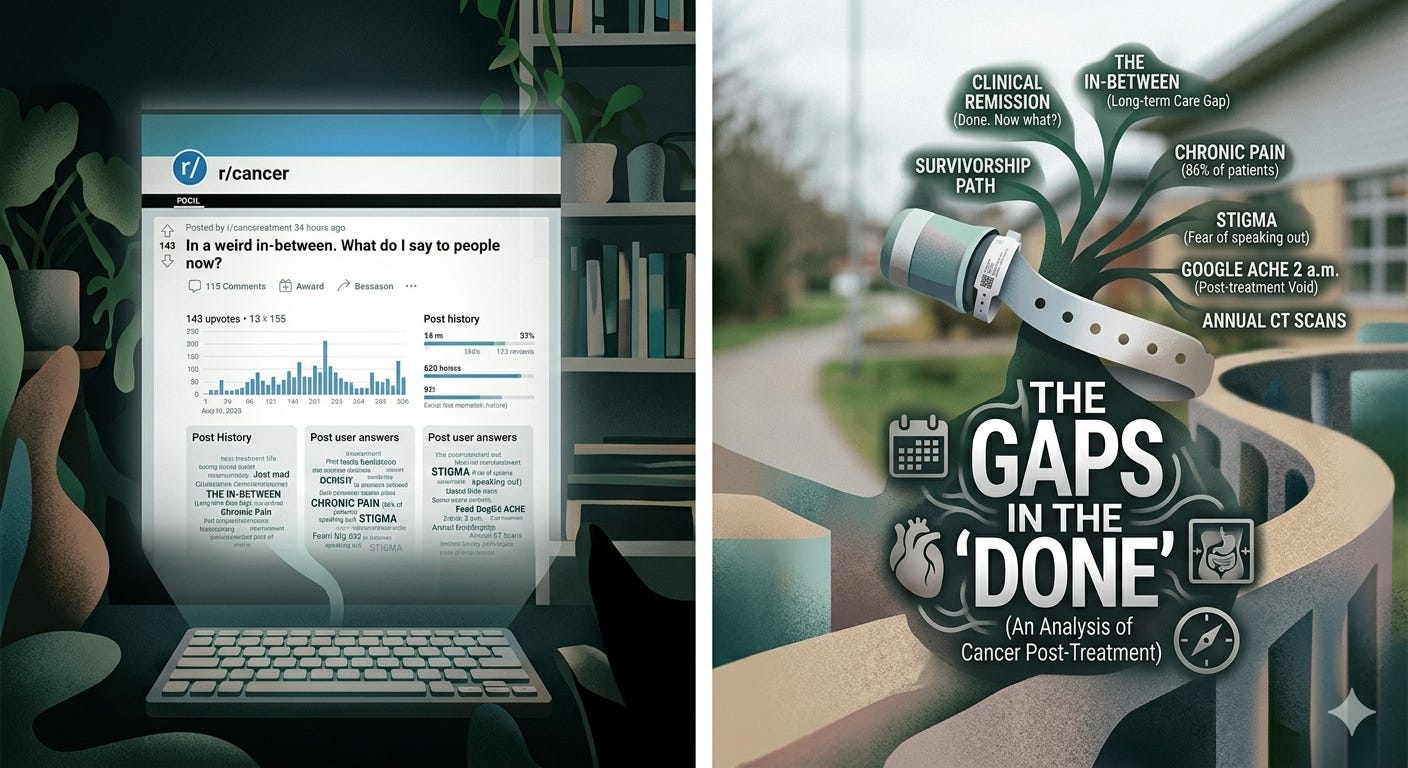
Now scroll Reddit. You’ve read these threads. Maybe you’ve posted in them. The one I keep thinking about pulled 143 upvotes and 115 comments under the title “In a weird in-between. What do I say to people now?” No physician in the thread. Just survivors trading the answers their care teams never wrote down.
What do I say when someone tells me yay, I’m done.
How do I tell my husband I’m not the same person.
When does the fear go away. Does it.
Every line is somebody trying to put words to a feeling they were told they shouldn’t be having. They’re not asking the question because they’re broken. They’re asking because the medical system declared them done while their calendars said otherwise, and nobody handed them the chapter they’re standing in. So they’re writing it. Comment by comment.
I had the resources to write my version. A husband who could travel. Financial stability. Friends who showed up. A family history that, perversely, had prepared me to navigate the system. Not everyone does. The 2 a.m. Reddit posts make that clear.
Disruption, Not Destruction
What everyone has access to is the smallest version of the moves I made.
Halfway through chemo, when the tumor was responding, Neal and I sat down and asked each other what we could do that might be fun after active treatment. We planned it during treatment.
We took a six-week trip that summer, partly to watch our son play summer collegiate baseball in upstate New York, partly to visit friends in Corsica, partly to bike in France. I named the trip the Fuck Cancer World Tour. The naming was the point. I named the annual abdominal CT scan, too. I called myself the winner of it, because abdominal cancers are hard to detect, and I’m getting yearly imaging that most people don’t get which can catch a tumor when it’s small and treatable. Disruption, not destruction.
You don’t need a world tour. You need one thing on one day that you chose for yourself. A book that costs more than you’d normally spend. A call to someone you haven’t talked to in a year. Five seconds at the kitchen window watching a hummingbird. The act of marking a day as something other than a day you endured.
My grandmother was 66 when her cancer metastasized. Three years later she and my grandfather were approaching their 50th wedding anniversary, and she wanted the party they’d been planning. The whole family flew to Florida. She put on a dress and danced with my grandfather, who had been dancing with her since the 1940s. A few weeks later she sat us all down and gave us things she wanted us to have. She handed me her tennis racket. I said, “Grandma, you’re going to need this.” She said, “Jojo, if I can play tennis again, your grandfather will buy me a new racket.”
She died three weeks after that, at 69. It’s 2026. The racket is still in my house.
She didn’t wait until things were good enough to celebrate. She celebrated because celebrating was the point.
WHAT YOU CAN DO THIS WEEK:
Ask your oncologist for a survivorship care plan, by name. If they don’t offer one, the National Coalition for Cancer Survivorship has a template you can bring to the appointment. You should know what surveillance you need, when, and who is coordinating among your specialists. This is not optional information.
If you’re on hormone therapy and the side effects are affecting your life, ask for a medication review. There are multiple options inside the endocrine therapy class. Dosing adjustments (see Dr. Andrea De Censi’s episode) and side-effect management strategies exist. You don’t have to white-knuckle through five more years.
Name one thing this week you are marking, not enduring. A meal. A walk. A call. A purchase. The size doesn’t matter. The act of choosing it does.
The 115 commenters on that Reddit thread aren’t asking now what because they’re broken. They’re asking because somebody handed them a word and forgot to hand them the calendar that goes with it.
The calendar is yours. Write the chapter.
SOURCES CITED:
National Coalition for Cancer Survivorship. 2024 State of Cancer Survivorship Survey. https://canceradvocacy.org/2024-state-of-cancer-survivorship-survey/
Maass SWMC, et al. “Long-term psychological distress in breast cancer survivors and their matched controls.” BMC Cancer, 2022. https://www.ncbi.nlm.nih.gov/pmc/articles/PMC8479978/
Fabbri MA, et al. “Adherence to Aromatase Inhibitor Therapy in Breast Cancer.” The Breast Journal, 2025. https://www.ncbi.nlm.nih.gov/pmc/articles/PMC12721728/
Hershman DL, et al. “Use of tamoxifen and aromatase inhibitors in a large population-based cohort.” British Journal of Cancer, 2011. https://www.ncbi.nlm.nih.gov/pmc/articles/PMC3101914/
City of Hope. Dealing With Emotions After Cancer Treatment. https://www.cityofhope.org/patients/survivorship/emotional-health-after-cancer-treatment
Cardiovascular Disease With Hormone Therapy and Ovarian Suppression in Premenopausal Breast Cancer Survivors. JACC: CardioOncology, 2024. https://www.jacc.org/doi/10.1016/j.jaccao.2024.08.006
Listen to the episode →. YouTube | Spotify | Apple | Everywhere