

The 5 Daily Habits That Reduce Cancer Risk Today (and the science behind each one)
Simple daily choices backed by science to lower your risk and take control of your health.

We talk about cancer like it lands out of a clear sky. Random, unlucky, something that happens to someone else, or something that waits politely for old age. For a lot of people, that’s wrong. Precancerous cells are common. Whether they ever turn into something that can kill you has a lot to do with the life you build around them.
The number of people diagnosed with cancer every year is on track to nearly double by 2050, from about 20 million to almost 35 million
The number of people diagnosed with cancer every year is on track to nearly double by 2050, from about 20 million to almost 35 million, and close to four in ten of those cancers are tied to risk factors we can control. It’s not just more people, either. Cancers that used to show up in someone’s 70s are now climbing in adults in their 30s and 40s.
And what’s saved the most lives isn’t the newest drug. Across five common cancers tracked from 1975 to 2020, prevention and early detection accounted for about 80% of the deaths that were avoided. Four out of five.
Across five common cancers tracked from 1975 to 2020, prevention and early detection accounted for about 80% of the deaths that were avoided
Watch or listen
YouTube | Spotify | Apple | Everywhere
Stay in the loop! Follow us on Instagram and Facebook for daily tips, exclusive updates, and highlights.
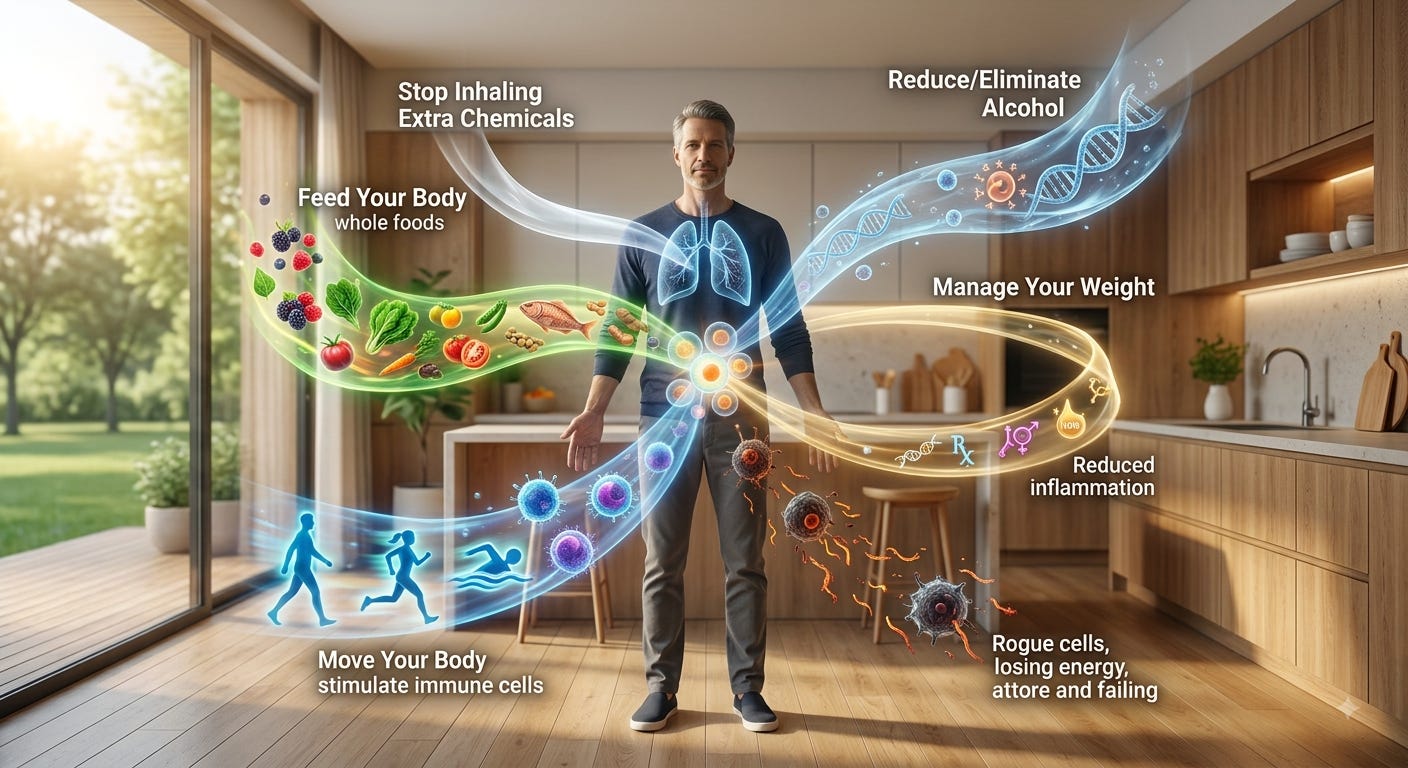
The 5 Daily Habits
1. Feed your body.
Every bite is an instruction to your body. Whole, unprocessed food, high-quality protein, and plenty of fruits and vegetables give your body the compounds it uses to defend itself and calm the chronic inflammation that helps rogue cells grow. The American Cancer Society’s diet and physical activity guideline points the same way: build meals around whole plant foods, and cut back on ultra-processed food, sugary drinks, and processed meat. That last one matters, because the World Health Organization classifies processed meat as a Group 1 carcinogen. That’s the deli-counter, hot-dog, bacon-in-a-package version, not a grass-fed steak.
2. Move your body.
Exercise is one of the best anti-inflammatories there is, and it does cancer-specific work: it helps regulate hormones like insulin and estrogen, steadies blood sugar, and wakes up the immune cells whose job is finding and destroying threats. The American Cancer Society recommends 150 to 300 minutes of moderate activity a week, which is 30 to 60 minutes, five days a week. What makes it stick isn’t willpower. It’s other people. Enroll in a class, make friends, and plan to see them afterward. We show up far more reliably for a person who’s waiting than for a benefit that’s decades away.
What makes it stick isn’t willpower. It’s other people.
3. Manage your weight.
Fat isn’t inert. It’s a metabolically active organ that sends out inflammatory signals and hormones, and carrying too much of it is linked to about 7% of all cancer deaths in the United States. So this isn’t about the number on the scale. It’s about turning down the volume on those signals, which the first two habits already start to do. If you and your doctor decide a GLP-1 helps you get there, go for it, and do resistance exercise for your bones and eat enough protein. The medication takes weight off. It doesn’t build the strong body underneath.
4. Reduce or eliminate alcohol.
We treat it as harmless. Your body treats it as a poison. The International Agency for Research on Cancer (IARC) classifies alcohol as a Group 1 carcinogen, the same category as asbestos and tobacco, and it raises the risk of at least six different cancers. When your body breaks it down, it produces acetaldehyde, a chemical that damages DNA, and DNA damage is where cancer starts. The American Cancer Society is blunt: for cancer prevention, it’s best not to drink at all. If you’re not going to stop completely, set real boundaries. Less is better. None is best.
Watch or listen
YouTube | Spotify | Apple | Everywhere
Stay in the loop! Follow us on Instagram and Facebook for daily tips, exclusive updates, and highlights.
5. Stop inhaling extra chemicals.
If you smoke or vape, this is the single biggest change you can make. Cigarette smoke carries more than 7,000 chemicals, at least 70 of them known to cause cancer, and smokers are about 20 times more likely to develop lung cancer. Vaping isn’t the safe swap it was sold as. The long-term cancer data is still coming in, but the aerosol isn’t water vapor; it carries its own mix of chemicals, some of them known to cause cancer. Every oncologist I’ve spent time with lately fears the same thing: a coming wave of lung, mouth, and throat cancers in people who believed vaping was harmless.
None of this is one heroic act, and there are no guarantees. Not every cancer traces back to these five. But the choices stack. The real food over the packaged version. The stairs. The second drink you pass on. You have far more say in your own health than anyone ever told you. You always did.
“You have far more say in your own health than anyone ever told you. You always did.”
Sources
https://www.cancer.gov/research/areas/public-health/early-onset-cancer-initiative
https://www.cancer.gov/about-cancer/causes-prevention/risk/alcohol/alcohol-fact-sheet
https://www.cancer.org/cancer/risk-prevention/diet-physical-activity/alcohol-use-and-cancer.html
https://www.cdc.gov/tobacco/about/cigarettes-and-cancer.html
https://www.cancer.org/cancer/risk-prevention/tobacco/e-cigarettes-vaping.html
Topics Discussed
Why cancer cases are set to double by 2050
The cancers now hitting people in their 30s and 40s
Why prevention beats treatment 4 to 1
Food as instructions, not just calories
The social trick that makes exercise stick
Body fat as a metabolically active organ
Where GLP-1s help, and where they don’t
Alcohol’s place next to asbestos and tobacco
Listen to more episodes: