
She Served Her Country. It Raised Her Cancer Risk.
87% higher risk of melanoma and 16% higher risk of breast and colorectal cancers
The base was beautiful, which is the part people never expect. It sat around a lake, ringed by palaces. If you have ever seen a photo of someone sitting on Saddam Hussein’s throne, it was probably taken there. Laura Pearson deployed early in the Iraq War, and every day she walked through a haze of black smoke to reach work, the chow hall, an errand. An older friend warned her not to go out when the smoke was heavy. Laura was young, and she loved to run, so she ran in it.

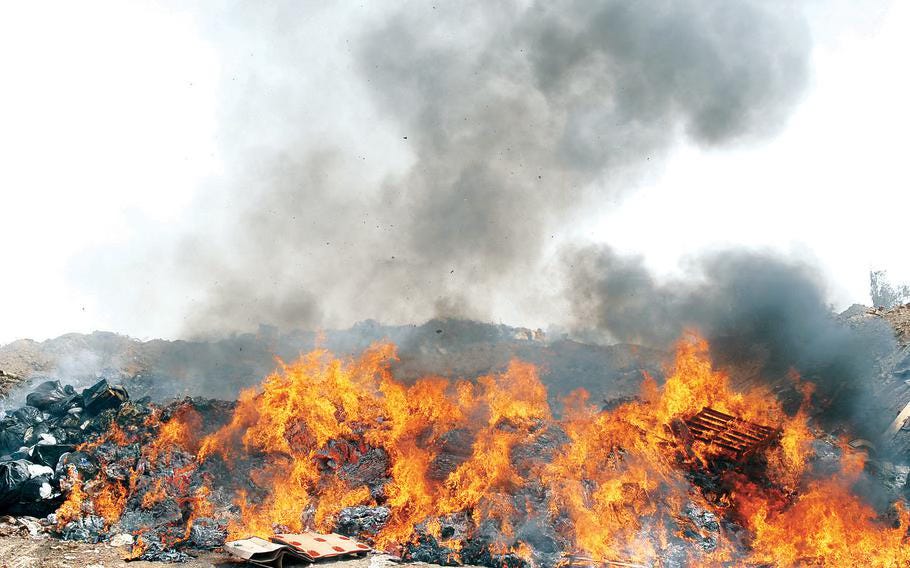
The smoke came from burn pits: open-air pits, sometimes acres wide, where the military incinerated everything a war produces, plastics and medical waste and electronics and fuel. Studies of deployed veterans have found foreign particulate lodged in lung tissue, including silica and titanium oxides. Laura does not know exactly what she breathed. Almost twenty years later, she felt a lump.
🎧 Get the full episode here:
Laura had a reason. Most of the people I talk to on Kicking Cancer’s Ass never get one. They ask “why me” and the honest answer is nobody knows. Laura’s cancer has a cause with a paper trail, a federal law, and a registry. And the medical system still made her fight to have it taken seriously.
The scale is bigger than one woman. In 2022 Congress passed the PACT Act, signed into law that August, which formally acknowledged the link between toxic exposures like burn pits and a long list of illnesses, and let veterans get care without first proving their service caused the condition. Millions of veterans have since gone through the VA’s new toxic-exposure screening. The American Cancer Society notes that burn pit smoke and its particulate matter may raise the risk of several cancers. This is federal policy now.
Breast cancer sits in a murkier, less-discussed corner of it. Research suggests rates run meaningfully higher, by some estimates 20 to 40 percent, among servicewomen and women veterans than in the general population, though researchers are careful to say the science on cause is not settled. Recognizing the gap, the VA now offers breast cancer risk assessments and mammograms to toxic-exposed veterans regardless of age, symptoms, or family history. Laura got a letter about some of this. Like a lot of us do with fine print, she read it and tucked it away.
Then came the diagnosis, and the second fight.
When Laura raised burn pits with her private oncologist, he shut it down. There is no way that caused it, he told her, and he would not write a letter connecting the two. She was not asking him to. She was asking a reasonable question: if my service raised my risk for this cancer, should I be screened for others? His answer, more or less, was that unless it was Agent Orange or radiation, she did not need to worry.
So she went to the VA. And the VA doctor said what she had been trying to get someone to acknowledge: what you were exposed to was much worse than Agent Orange. Good thing you are here.
What you were exposed to was much worse than Agent Orange. Good thing you are here.
The private system, the one we are taught to trust, waved her off. The VA, the one Laura had avoided for years, saw the whole picture. That avoidance is its own story, and it is not only Laura’s. Women veterans use VA healthcare at lower rates than men. Laura had been challenged for parking in a veterans spot. She had been told “at least you weren’t on the front line,” as if being mortared did not count. Somewhere in there, a lot of women simply stop mentioning they served. They do not wear the hat. They do not use the benefits they earned. The system built to catch exactly Laura’s kind of cancer is the one women are least likely to walk into.
Look at what the VA actually did right. It screened Laura on her exposure history, not just her age and her family tree. That is risk stratification, and it is the whole game. Age and family history are useful, but they are not enough. On their own, they miss the woman who is young, low risk on paper, and quietly carrying an exposure nobody asked about. If we are going to catch early-onset cancers before they turn advanced, screening has to weigh environmental, familial, and lifestyle risk together. The VA reached Laura because it asked what she had been exposed to. Most of medicine still does not ask the question. And no one should tell a patient a lump is nothing without the pathology to prove it. Laura’s doctor was probably right by the odds. Laura was right about her body.
For surgery and reconstruction, Laura went to private surgeons, because that is not what the VA is known for. But for oncology and the follow-through, she chooses the VA now, and she has excellent private insurance. She told me about a VA doctor who called her twice to chase down a blood test she kept skipping. Twice. Most of us cannot get one callback.
Laura’s story is about who gets believed about their own body. She had the rare gift of an answer, and she still had to push past a doctor who did not want to hear it. If she had accepted the first reassurance about the lump, or the brush-off about the cause, she would know less about her own risk today. She got answers because she refused to stop asking.
Laura says - her doctor has many patients. She has one life. She researched what to request before she walked in. She put her name on the burn pit registry when a colleague pushed her, even though she felt fine. When the first oncologist would not take her seriously, she found the next.
When the first oncologist would not take her seriously, she found the next.
Twenty years ago, Laura ran through that smoke because she was young and it was in her way. It was what she was ordered to do in service of her country. The same exposure that put the cancer in her body is the one fact that finally got her heard. She cannot change what she breathed. She could decide, every step after, to be the one asking the questions.
Sources
https://preventcancer.org/article/what-all-veterans-should-know-about-their-cancer-risk/
https://www.frontiersin.org/journals/environmental-health/articles/10.3389/fenvh.2024.1364812/full
https://www.va.gov/resources/the-pact-act-and-your-va-benefits/
https://www.cancer.org/cancer/risk-prevention/chemicals/burn-pits.html
https://thewarhorse.org/military-women-face-higher-breast-cancer-rates-from-exposure/
https://www.frontiersin.org/journals/oncology/articles/10.3389/fonc.2024.1356001/full
https://www.womenshealth.va.gov/materials-and-resources/facts-and-statistics.asp


