

The steroid was making me vibrate.
Not shaking. Vibrating. Four in the afternoon after an infusion, sitting perfectly still in a chair, my whole body humming at a frequency nobody else in the room could hear. I couldn’t sleep without taking something to get there. It’s a strange thing to be exhausted and buzzing at the same time.

The steroid is part of chemo. It’s there to keep you from reacting to the drugs and to hold the nausea down. It works. It also turned my afternoons into something I dreaded separately from the chemo itself.
So I asked my oncologist if we could lower it.
We lowered it. Then I asked again. We lowered it again. We kept going, round after round, watching my counts and watching how I felt, until I was getting one-eighth of the dose I’d started on.
My immune system stayed in great shape. I stopped vibrating. I slept.
One-eighth.
I didn’t out-research my oncologist. I didn’t go around her. I picked a team at the cutting edge of what’s possible so that I could trust them, and I did. All I did was tell them the truth about how I felt and ask a question.
It worked. It was easy. And nobody offered.
Maximum tolerated is not the same as minimum effective
When a cancer drug goes through trials, the early phase is largely built to answer one question: how much of this can a person take before it does unacceptable harm? Push the dose up until the toxicity becomes intolerable, back off a notch, and that’s your number. Maximum tolerated dose. It’s a logic inherited from the old chemotherapy era, when more poison genuinely did mean more dead cancer cells.
That number goes on the label. And once it’s on the label, it becomes the standard of care for everyone. Often, an 110-pound woman and a 250-pound man get the same number of milligrams. The person whose liver clears it quickly and the person whose liver clears it slowly get the same number of milligrams.
The question nobody’s trial was designed to answer is the one that actually matters to you: what’s the least amount of this drug that still does the job in my body?
Dr. Andrea De Censi spent his career asking that question, which made him unusual. When he ran the trial on tamoxifen, he found that 5mg delivered the same roughly 50% risk reduction as the standard 20mg dose, without an increase in serious side effects. Somewhere between 30 and 50% of women prescribed tamoxifen stop taking it because they can’t live with how it makes them feel. Most of them are never told a lower dose exists.
A drug that works, abandoned by up to half the people who need it. A version that works about as well and is far easier to live with, sitting right there the whole time.
“I felt like I was failing as a patient”
Annabelle Gurwitch has been living with Stage 4 lung cancer for five years. She never smoked. She was 60 when she walked into urgent care for a COVID test.
Her targeted therapy was, in her words, unlivable. There were days she slept more than she was awake. Days she couldn’t leave the bathroom. And she kept taking the full dose, because she believed that was what a patient was supposed to do.
“I felt that I was failing as a patient by not being able to tolerate this dosage,” she told me. “This idea that I had to fight and be a warrior.”
She asked for a change only after her adult son found her passed out on the bathroom floor.
She’s been on half the recommended dose ever since. Five years. Stable. She still has side effects. They’re tolerable.
Toxicities are systematically underreported. Not because patients are stoic by nature, but because we’ve built a culture that tells people in treatment that suffering is the job. If you’re a warrior, saying “this is unbearable” sounds like surrender. So people don’t say it. And the trial data quietly reflects a version of tolerability that isn’t real.
There’s a patient advocacy group founded by breast cancer survivors called The Right Dose, working on exactly this. Moving the metric from max tolerable to minimum effective.
Lower isn’t the compromise
Minimum effective dosing is not a comfort upgrade. It is not choosing an easier life over a longer one. Read the KFF Health News reporting on this, and you find the same story again and again: people who went lower did better.
Annabelle is alive five years into Stage 4 lung cancer on half her dose, and the half she’s living is worth living. I slept, and sleeping is how a body repairs itself. Up to half the women prescribed tamoxifen quit, and 5mg is not 25% of the protection of 20mg. It’s the same protection, taken by someone who’s still taking it.
A dose you can’t tolerate is a dose you stop taking. A drug you stop taking doesn’t work at all. Adherence isn’t a soft outcome; it’s the whole outcome, and we’ve built a dosing system that treats it as somebody else’s problem.
Lower isn’t the compromise. Lower is often the better result.
Follow the money, because it isn’t following you
I used to think this was inertia. Medicine is conservative, guidelines lag, doctors are busy. All true.
It’s also money.
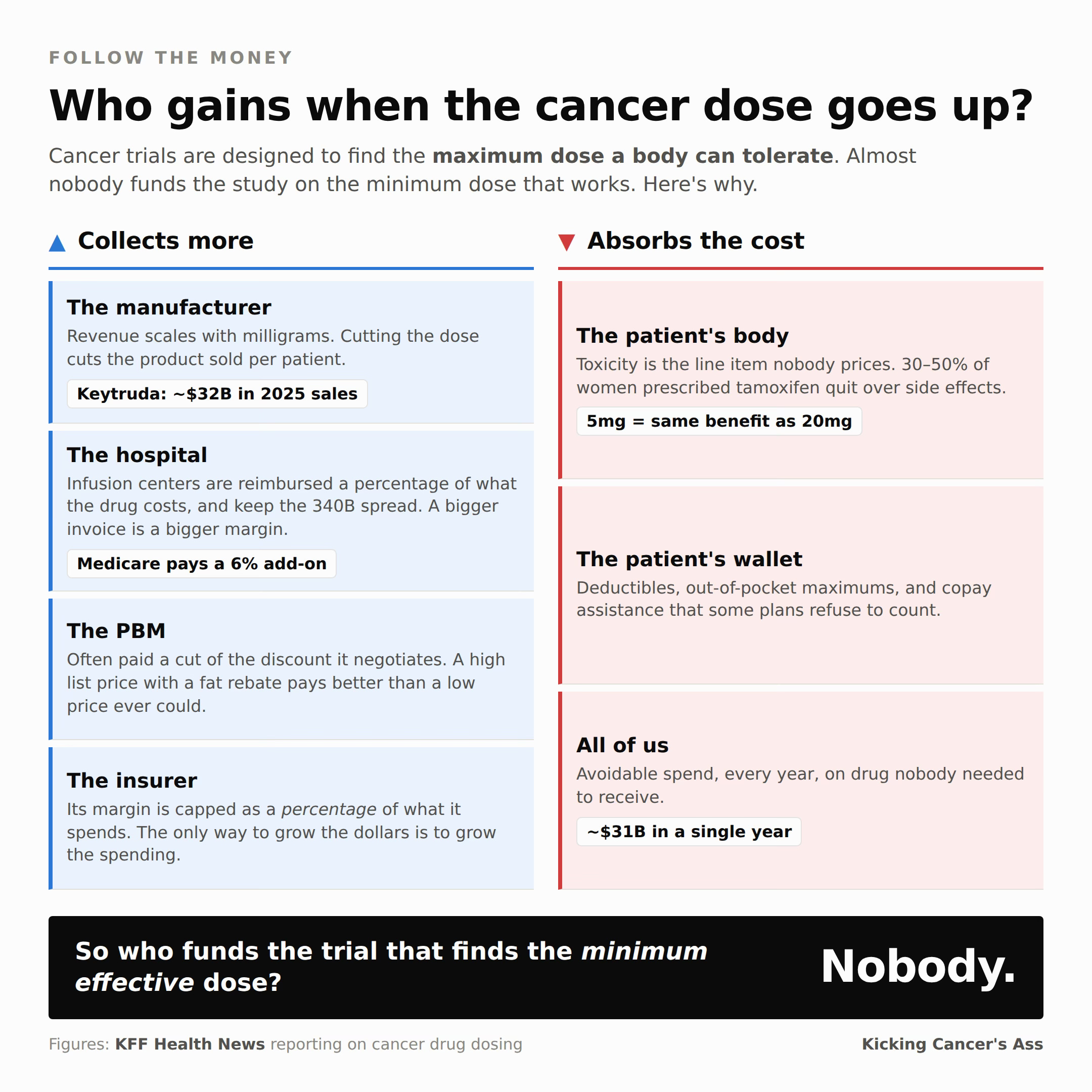
Hospitals are reimbursed a percentage of a drug's cost, which means an expensive infusion is a revenue line item, not just a treatment. Manufacturers sell more drug at the higher dose. Pembrolizumab alone did roughly $32 billion in sales last year. Nobody in that chain has a financial reason to fund the study that would cut the dose in half.
In India, physicians are reporting real results with nivolumab at as little as one-twelfth of the labeled dose. Canada, Israel, and Sweden already use lower doses or shorter courses for some regimens. The Veterans Health Administration ran a pilot that simply spaced out pembrolizumab dosing and saved $1.5 million across three hospitals in two years, while making treatment less burdensome for the patients. One study estimated that minimum necessary dosing across the board could have saved the American system around $31 billion in a single year.
One study estimated that minimum necessary dosing across the board could have saved the American system around $31 billion in a single year.
The FDA has noticed. Project Optimus, launched in 2021, pushes drugmakers to study dosing more carefully before approval. It’s real progress for new drugs. It does almost nothing for the ones already on the market, because the agency can’t compel a company to go back and study a lower dose of a product that’s already selling.
So the incentive to find your minimum effective dose sits with exactly one person. You.
And then there’s the PBM lawsuit
Annabelle is now the lead plaintiff in a class action against pharmacy benefit managers, and the mechanism she’s fighting is worth understanding even if you never take a targeted therapy.
Drug companies run patient assistance programs that put money toward your medication. Some insurers and PBMs have decided that money doesn’t count toward your deductible or out-of-pocket maximum, on the theory that these drugs are nonessential because they’re not on the standard formulary. So the assistance gets collected, and you still owe the full deductible.
She calls it double dipping. It’s already illegal in about half the states. Federal legislation to fix it has failed repeatedly, which is why there’s a lawsuit. More than 80 patient organizations are pushing on it through the All Copays Count Coalition.
Same pattern as the dosing. The structure isn’t broken. It’s working perfectly, for someone who isn’t you.
Why asking better questions isn’t enough
I believe in self-advocacy. I’ve built a whole show around it. Ask the questions. Understand what you’re being given and why. Find a team you trust, and if you don’t have one, go get one.
And I got lucky, in a specific way: I had the language, the confidence and the relationship to ask my oncologist to keep lowering a dose. Plenty of people don’t. Plenty of people are on their fourth infusion, feeling like they’re losing their mind, certain that this is simply what cancer treatment feels like.
You can’t fix an incentive structure one appointment at a time.
Matthew Zachary has been arguing this for years, and he’s finally building a patient-powered movement. There are roughly 50 million Americans living with cancer, or after it, plus everyone who loves them, and until now that group has had essentially zero coordinated political power. Every other constituency in health care has a lobby. Patients have GoFundMe.
WeThePatients.org is his attempt to turn that into a voting bloc, with a specific ask: a reimbursable nurse navigator at every cancer center, a legally protected patient advocate written into state law, and bankruptcy protection that starts before your first treatment does.
That’s the level where dosing gets fixed. Not because a hospital suddenly decides to bill less, but because enough people demand that the standard of care be built around what’s best for the patient, and enough legislators need those votes.
What to do Monday
If you or someone you love is in treatment:
Share every side effect and discomfort you might be feeling. Nothing is irrelevant or too embarrassing. Ask what the evidence is for the dose you’ve been given, and whether it was studied at lower levels. Ask what would change in the plan if the side effects became unlivable. Vibrating at four in the afternoon is data. Report it.
And if a dose reduction is on the table, ask what they’ll monitor to know it’s still working.
Never adjust or stop a cancer medication on your own. The entire point is to have the conversation with your team, not around them.
If you want the healthcare industry to focus on minimum effective dose, get involved. Go look at WeThePatients.org, even if you’re perfectly healthy today. Because the version of this system you’ll meet when it’s your turn is the version we tolerate right now.
Minimum effective dosing should be the standard, not the exception you have to be lucky, educated, and stubborn enough to ask for. That’s not a favor anyone is going to grant us, one appointment at a time.
We have to go get it together.
Kicking Cancer’s Ass Episodes:
Dr. Andrea De Censi on low-dose tamoxifen,
Annabelle Gurwitch on max tolerable versus minimum effective, and
Matthew Zachary on building a patient voting bloc.
The reporting that prompted this piece is here, from KFF Health News.