Loving You Was Never Just Keeping You Alive
The greatest love prepares the world for your absence.
My grandmother married my grandfather when she was nineteen and he was twenty-one. They got fifty years. Near the end of hers, while the rest of us were still saying the useless, loving thing (“you’re not going to die, don’t talk like that”), she was doing something else entirely.
She gave me her tennis racket. I was a kid about it. “Grandma, this is your racket. What about when you want to play?” She looked at me like I was sweet and a little slow and said, “Honey, if I can play tennis again, your grandfather is buying me a new one.”
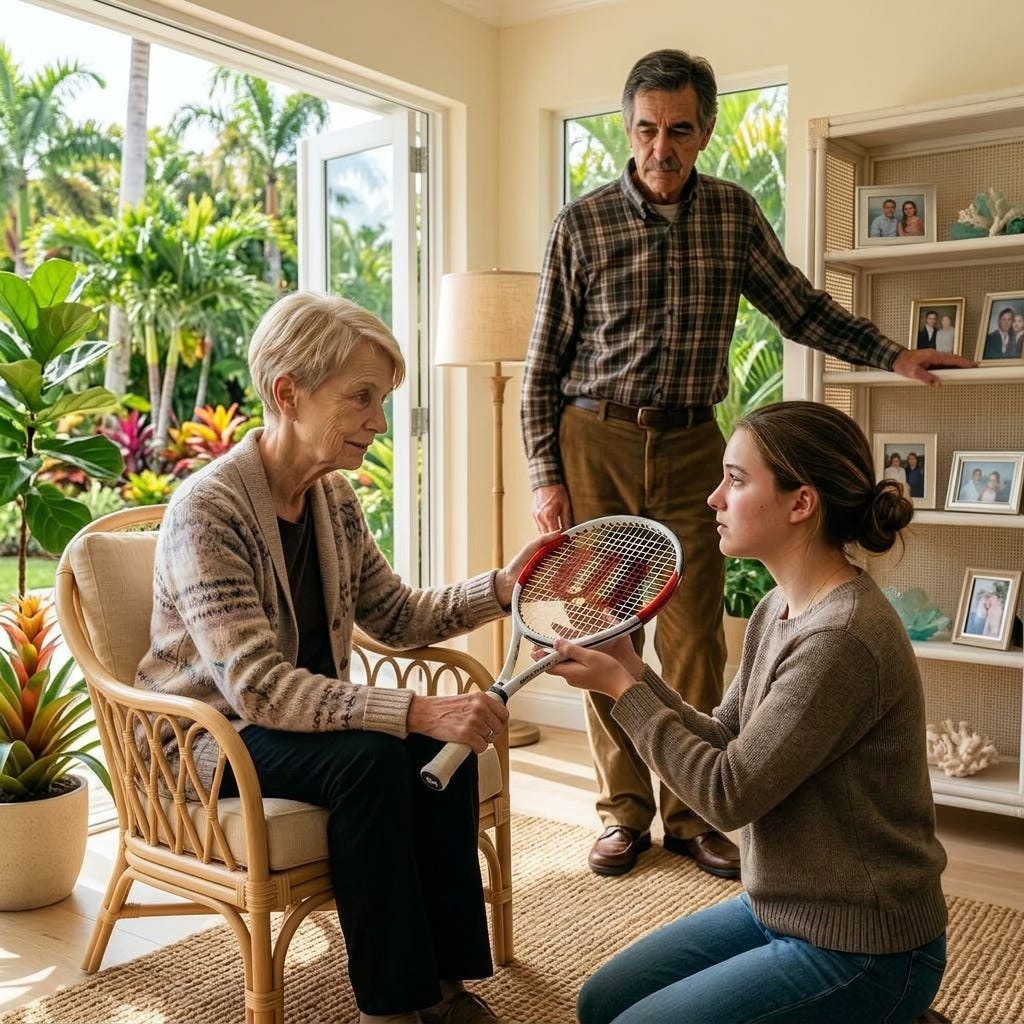
Privately, she turned to him. Fifty years, and she told him he was no good alone. That it wasn’t good for him, and it wasn’t what she wanted for him. She told him he should date. She named the woman he should call. He protested that the woman was already seeing someone. My grandmother, dying, said, “Yeah. She won’t be. Give it time.”
She was right. When my grandfather started dating, months after we lost her, the whole family exhaled instead of bracing. Grandma had already handed us permission. She had done the most loving thing I have ever watched a person do, which was refuse to turn her love into a cage.
I told that story this week to Dr. Monique Nugent, a hospitalist, which means she is the doctor you do not get to choose and only meet when everything is moving fast. She spends her career in the five days that change a family. And she has a phrase for the trap my grandmother stepped around. She calls it “I love you, so I keep you around.”
Hear my story at Prescription for Admission and get Monique’s wisdom on Kicking Cancer’s Ass.
Watch or listen to Kicking Cancer’s Ass
YouTube | Spotify | Apple | Everywhere
The day before we recorded, Monique had a patient in her nineties, a full code, meaning that if her heart stopped, she would get CPR, shocks, a tube, the ICU, all of it. Monique asked the adult child whether that was really what they wanted. The answer was, “Yes. I love my mother.” Love, here, meant: keep doing the thing that may be hurting her.
Monique wants us to think about love differently. Love does not have to mean prolonging suffering.
Part of why we get this so wrong is the language we inherited. We talk about cancer as a war. You fight it, you beat it, she’s a warrior, she won’t lose. People hear the name of my show and assume I’m waving the same flag. I’m not, and the research is part of why. When researchers actually tested battle language, they found it backfires. In a set of studies, people shown “war” and “battle” framing of cancer became more fatalistic about prevention and no more vigilant about it. Fighting words made the disease feel more like destiny, not less. Monique put it more bluntly than any study: it is not a competition between your loved one and out-of-control lymphocytes. It is a human being, deciding how they want to live in the body they have.
The war frame does something quieter too. It makes honesty feel like treason. If stopping is “losing,” then nobody at the table can say the true thing out loud. So patients protect us. They hide side effects, they downplay the pain, they nod along, because telling the truth feels like letting everyone down. They may not even realize what the truth is. Among patients with advanced lung or colorectal cancer who were receiving chemotherapy that could not cure them, most did not understand the treatment was not going to cure them. Sixty-nine percent with lung cancer, eighty-one percent with colorectal. The gap between what people are told and what they can bear to hear is enormous, and it is widest with the specialists they love and don’t want to disappoint.
Among patients with advanced lung or colorectal cancer who were receiving chemotherapy that could not cure them, most did not understand the treatment was not going to cure them.
Which is exactly why the interloper gets the truth. Monique walks in as a stranger, and patients tell her everything, precisely because she has no stake in their performance. A husband can ask her to be the villain. A patient can admit they’re done. There is room to be honest with someone who isn’t keeping score of your hope.
I think this is partly a planning problem, and we can change how we plan and discuss our care preferences. The hard conversation is not just kinder. It measurably protects the people left behind. Patients with advanced cancer who had honest end-of-life discussions received less aggressive care at the end and, through that, their caregivers had better bereavement outcomes. And when families actually do the advance care planning, when wishes are known and written down, surviving relatives show less stress, anxiety, and depression. The conversation everyone avoids is the one that spares your family years of second-guessing.
Monique gave me the cleanest frame I’ve heard for why. There’s a difference, she said, between a decision-maker and a proxy. A decision-maker decides what they think is best. A proxy acts as if they are you. If you’ve had the conversation, if you’ve made the words come out of your mouth (“this is my line, I would not want to be tube-fed, I do not want to be intubated”), then your family never has to guess what you’d want. They get to honor you instead. That guilt that gets released, she said, is a gift. A huge one.
A decision-maker decides what they think is best. A proxy acts as if they are you.
None of this requires a lawyer to start. If you want help finding the words, The Conversation Project has free guides built for exactly this kind of talk. When you’re ready to put it in writing, the National Institute on Aging explains living wills and health care proxies in plain language, and CaringInfo, run by the National Hospice and Palliative Care Organization, has free advance directive forms for every state. Print one. Fill it in imperfectly. You can change it right up to the last moment, as long as you’re of sound mind.
That is what my grandmother understood in her bones, decades before I had any research to hang it on. The tennis racket was not surrender. Telling my grandfather to find a new, loving partner wasn’t defeat. It was an instruction. She wasn’t quitting the game. She was telling the people she loved exactly how to keep playing once she couldn’t.
Love that plans for the world without you in it is not a smaller love.
It is a gift.
She gave away the racket so nobody would have to wonder. Then she guided my grandfather to enjoy his life with someone else.
Prescription for Admission - https://drmoniquenugent.com/podcast/
Watch or listen
YouTube | Spotify | Apple | Everywhere
Stay in the loop! Follow us on Instagram and Facebook for daily tips, exclusive updates, and highlights.
Sources
Hauser & Schwarz, “The War on Prevention II,” Health Communication (2019): https://dornsife.usc.edu/norbert-schwarz/wp-content/uploads/sites/231/2023/12/20_HC_Hauser_Schwarz_War_on_cancer_II.pdf
Weeks et al., “Patients’ Expectations about Effects of Chemotherapy for Advanced Cancer,” NEJM (2012): https://www.nejm.org/doi/full/10.1056/NEJMoa1204410
Wright et al., “Associations Between End-of-Life Discussions and Caregiver Bereavement Adjustment,” JAMA (2008): https://jamanetwork.com/journals/jama/fullarticle/182700
Detering et al., “The impact of advance care planning on end of life care in elderly patients,” BMJ (2010): https://pubmed.ncbi.nlm.nih.gov/20332506/
The Conversation Project, free end-of-life conversation guides: https://theconversationproject.org/get-started
National Institute on Aging, advance care planning: https://www.nia.nih.gov/health/advance-care-planning
CaringInfo (NHPCO), free state-by-state advance directive forms: https://www.caringinfo.org/planning/advance-directives/


