
Is Ulipristal Acetate a Hormone?
And Other Questions Cancer Survivors Shouldn’t Have to Google at Midnight

After the conversation with Dr. Sacha Howell about ulipristal acetate as the first real pharmacological prevention option for triple-negative breast cancer, the question I got most often was some version of this:
Wait. Is that a hormone? I’m not supposed to take hormones.
Fair question. We should actually be asking: why is the word “hormone” doing so much work in cancer care, and why does nobody stop to explain that it means several completely different things?
Short answer on ulipristal acetate: No, it isn’t a hormone. It’s a blocker. It sits in the parking spot, so your own progesterone can’t park there. Your body keeps making progesterone at the levels it was always going to make. The drug just stops that progesterone from delivering its message to certain tissues. That’s a different category of medicine than “taking hormones”.
I figured this out the hard way, as most of us do.
When I had my ovaries removed at 38 because of my BRCA1 mutation, I crashed into menopause on a Tuesday. I was immediately put on hormone replacement therapy — progesterone and testosterone, no estrogen, because the family history made estrogen too risky. That regimen was my norm for 14 years. Right up until the breast cancer diagnosis, when all of it stopped.
For two years of treatment and early recovery, I managed hot flashes with non-hormonal medication. As we approached year three, I started the conversation with my team about whether HRT could come back — not just for hot flashes, but for bone density, libido, and cardiovascular protection. That conversation is still open. It will be open for a while. And the reason it’s complicated is the same reason this whole topic is complicated: “hormone” isn’t a single category.
So here’s the framework I wish somebody had handed me on day one.
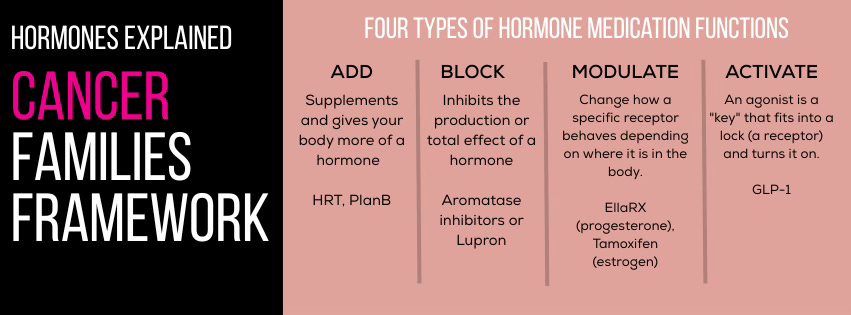
Supplements add. Traditional HRT, birth control pills, insulin, thyroid medication, testosterone — these give your body more of something it isn’t making enough of, or override what it is. When your doctor says “no hormones during treatment,” this is what they usually mean: don’t add estrogen to a body that just finished treating an estrogen-fed tumor.
GLP-1 drugs — Ozempic, Wegovy, Mounjaro — belong in this bucket too. They mimic a hormone your gut already makes. That’s worth knowing, because the conversation about GLP-1s and cancer risk is still being written, and survivors are making decisions about them right now with incomplete information. If your oncologist tells you to avoid hormones, ask specifically whether GLP-1s are included, because they are a hormone, even though nobody calls them that in the pharmacy.
Blockers subtract. Tamoxifen, aromatase inhibitors, ulipristal acetate — these don’t add anything. They either stop your body from making a hormone (aromatase inhibitors shut down estrogen production in post-menopausal tissue) or they occupy the receptor so the hormone can’t land (tamoxifen for estrogen, ulipristal for progesterone). Some do both in different tissues at the same time, which is why ulipristal is technically a modulator — blocker in the breast, partial stand-in elsewhere. Same molecule, different jobs depending on which tissue it shows up in.
Then there’s everything else your endocrine system does. Cortisol. Insulin. Thyroid. Oxytocin. Most of these have nothing to do with your cancer. But when a survivor hears the word “hormone” attached to any of them, the alarm goes off.
That alarm is not your fault. It’s the system’s fault for using one word to mean four or five things.
I’m not a doctor. I can’t tell you whether ulipristal acetate belongs in your prevention conversation (the research was just published in December, and it’s early days), whether a GLP-1 is right for your body, or what the HRT question looks like on the other side of your treatment. Those are conversations for your team.
What I can tell you is this: the next time somebody tells you a drug is or isn’t a hormone, ask them a better question. Does it add, block, or modulate? Which hormone? And in which tissue?
You have the right to a real answer.