
Hacking Biology for More Happiness
Lining your life with Happiness Tripwires or How to Make Rough Days Suck Less

Infusion centers are weird places. The chairs are comfortable, but the rooms are freezing. You are there for hours, tethered to a pole. The machines are constantly beeping, alerting nurses to blockages or empty bags, providing a relentless, audible reminder that you are in a place where people are fighting for their lives.
It is heavy. It is dark. And frankly, it sucks.
Most people walk into that room feeling like a victim. You feel small. You feel like a patient receiving poison. I know that feeling because I’ve been there. But by the time I reached the end of my 12 cycles of chemotherapy for triple-negative breast cancer, something strange happened.
My oncologist looked at my blood work and said, “Your labs don’t look like a chemotherapy patient’s labs.”
Was I just uniquely tolerant to the toxins? Maybe. But another factor was at play. I believe it was the Happiness Tripwires.
If you walked by my chair on Wednesdays, you wouldn’t have seen a woman cowering in fear. You would have seen a woman laughing. You would have seen me reading letters, smelling essential oils, and cracking jokes with my friends. I wasn’t in denial. I was deploying a strategy.
I wasn’t just “thinking positive.” I was engineering my biology to give myself the best possible odds.
The Science: Why Happiness is Good Medicine
Let’s get one thing clear: I am not talking about “toxic positivity.” I’m not telling you to smile when you’re in pain or to pretend that cancer isn’t scary. Cancer is a curveball, and it’s terrifying.
But while you cannot control the diagnosis, you can control your body’s chemical environment.
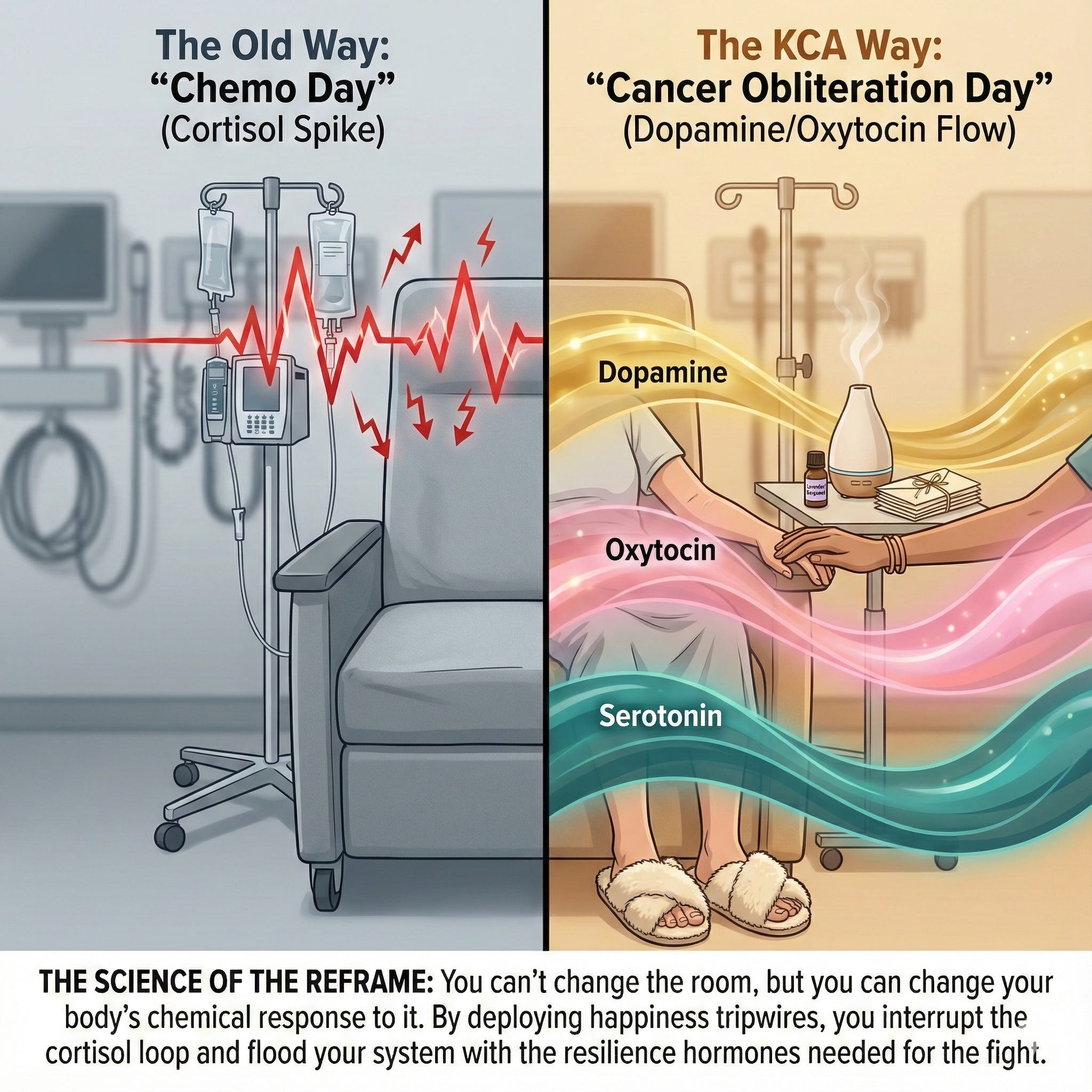
When you are stressed, fearful, or feeling like a victim, your body floods with cortisol. Stress suppresses your immune system—the exact system you need firing on all cylinders to fight the cancer.
“Happiness Tripwires” are deliberate, small actions or objects placed in your path to trigger a different chemical response. They release the “holy trinity” of happy hormones: Oxytocin, Dopamine, and Serotonin.
Dopamine is the reward chemical. It improves motivation and focus.
Serotonin stabilizes your mood and feelings of well-being.
Oxytocin is the “love hormone,” released during bonding and trust.
Neuroscience demonstrates that these hormones don’t just make you “feel good”—they improve resilience, creativity, and decision-making. They bolster your immune system. So, setting up these tripwires isn’t just a nice thing to do to pass the time. It is a medical strategy. It is part of your treatment protocol.
Step 1: The Reframe
The first tripwire is entirely mental. You have to change the name on the calendar.
Stop calling it “Chemo Day.” “Chemo Day” implies you are passively sitting there while toxic drugs are pumped into your veins. It sounds miserable because it is miserable.
I renamed my Wednesdays “Cancer Obliteration Day”.

This wasn’t a day I had to endure; it was a day I got to attack the unwelcome invader in my body actively. I wasn’t a victim. I was a survivor putting on my armor. I was deploying resources to wipe the cancer out.
This simple reframe changes your posture. You walk into the infusion center with agency. You are the CEO of your own body, and the chemo is just one of your employees doing its job.
Step 2: Stack the Tripwires
A single moment of joy is nice, but to change your state during a 6-hour infusion, you need volume. You need to stack them. You need tripwires upon tripwires upon tripwires.
Here is exactly how I engineered my Cancer Obliteration Days to maximize my power:
The Morning Ritual: I was cold-capping to save my hair, which meant I could only wash it once a week. I made that wash happen on infusion mornings. It became a self-care ritual. I couldn’t blow dry it, but that clean feeling was a small win.
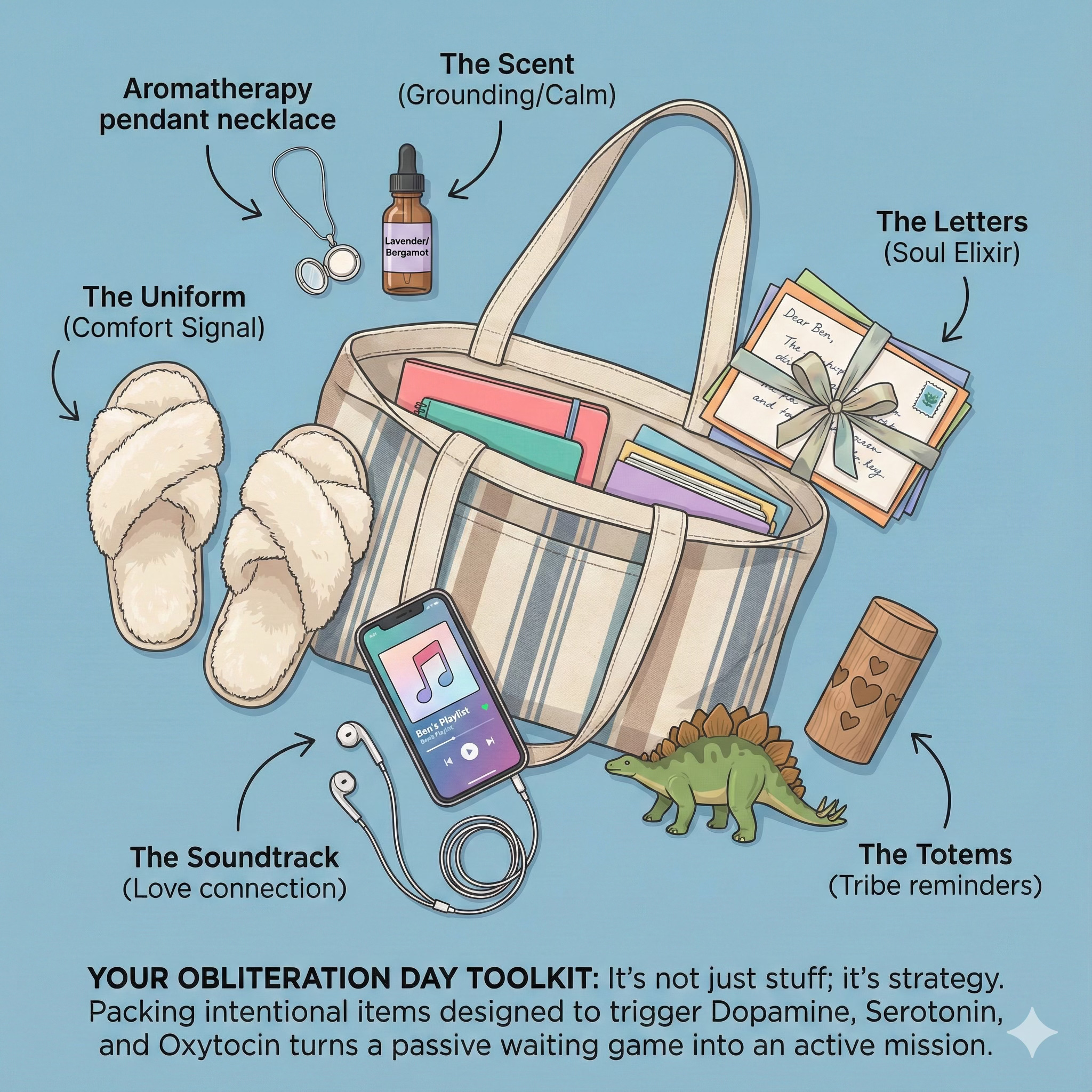
The Uniform: I bought fluffy slippers that I only wore on chemo days. As soon as I got to my recliner, the shoes came off, and the slippers went on. It signaled to my brain: We are safe here. We are comfortable.
The Scent: Hospitals smell like antiseptic and anxiety. I countered that with aromatherapy. I wore a pendant necklace that diffused lavender or bergamot. It transported me out of the clinic and grounded me.
The Soundtrack: My son Ben, who was away at college, made me a playlist. Listening to it wasn’t just about the music; it was a connection to him. It was a sonic tripwire that flooded me with love.
The Letters: My middle son, Taylor, wrote me a letter for every single infusion. I would save it and read it in the chair. It was an elixir for my soul.
The Banter: My high school friend Julian texted me every chemo day with emojis and jokes. We had playful banter that had nothing to do with cancer. It was a distraction, sure, but it was also a reminder that I was still Joelle, not just a cancer patient.
The Objects: My friend Shira gave me a small wooden cylinder with twelve hearts inside, each listing a reason she loved me. I put it on my side table next to “Stego,” a toy dinosaur. These weren’t toys; they were totems of my tribe.
Step 3: Appoint a Chief Logistics Officer
You cannot do this alone. You need a team.
My best friend, Jessica, became my “Chief Logistics Officer” and the “Air Traffic Controller of Love”. She organized the friends, the rides, and the food. She ensured that I never sat in that chair alone.
Having a friend by your side does two things: it distracts you from the beeping machines, and it releases oxytocin through connection. We laughed at the robot delivering the meds. We shared desserts. We made the infusion center our living room.
The Result: Power Over Powerlessness
Did these tripwires cure my cancer? No. The Taxol and Carboplatin did that.
But the tripwires saved me.
They saved my spirit. They kept my body strong enough to handle the treatment. They turned what could have been the most traumatic year of my life into a year where I felt held, loved, and surprisingly happy.
I didn’t feel like a diagnosis. I felt human.
Your Turn: Design Your Tripwires
If you are facing a diagnosis, or if you love someone who is, I want you to pause right now and make a list.
What are the small things that make you smile?
Is it a texture? (A soft blanket, specific socks).
Is it a taste? (A specific tea, a hard candy).
Is it a sound? (A playlist, a podcast, a voice note).
Is it a connection? (A text, a meme, a photo).
You don’t have to be rich to do this. Most of my tripwires were free—letters, texts, playlists. The cost isn’t the point. The intention is the point.
Cancer came to you. You didn’t choose the pitch. But you get to choose the swing. You get to decide how you go through it.

So, pack your bag. Put on your armor. Stack your happiness tripwires. And go kick cancer’s ass.
To your power,
Joelle
Host, Kicking Cancer’s Ass
P.S. It will help me reach more people who need these insights if you like, comment, rate, and share the YouTube, Spotify, and Apple episodes. Can you take one minute and do that for me?
Sources & Further Information
Primary Source:
Book: Crushing the Cancer Curveball by Joelle Kaufman. (See chapters on “Treatment Protocols” and “Survivorship” for detailed patient strategies).
Podcast: Kicking Cancer’s Ass, Episode: “Happiness Tripwires” (Available on all audio platforms and YouTube).
Scientific Context:
Hormonal Regulation: For more on the physiological effects of positive psychology (Dopamine, Serotonin, Oxytocin) on stress reduction and immune function, refer to research on the “biology of hope” and psychoneuroimmunology.
The Biology of Hope & Immune Function: This overview from the University of Minnesota’s Earl E. Bakken Center for Spirituality & Healing details how positive emotions broaden perspective and build resilience, citing research from Dr. Barbara Fredrickson on how positivity can speed recovery from cardiovascular stress and improve immune function.
Social Support & Immunity: A study published in the National Library of Medicine (PMC) detailing the “social psychoneuroimmunology” mechanisms—specifically how positive social contexts (like Joelle’s “Killer Team”) regulate the HPA axis and reduce inflammation.
Workplace & Resilience Applications: Concepts of “Happiness Tripwires” are also adapted for leadership and sustained success strategies.
Harvard Business Review / Shawn Achor: This is the foundational HBR article often cited regarding the “Happiness Advantage.” It details the meta-analysis showing that happiness precedes success (not the other way around) and leads to a 31% increase in productivity.
Microsoft WorkLab: This research visualizes the brain wave activity of people taking breaks versus those who don’t. It scientifically validates the need for “tripwires” (breaks/rituals) to prevent the beta-wave buildup associated with stress and burnout.